Thought work has been instrumental, and realizing that everything that happens in our lives–good and bad–is neutral until we make it mean something.
Beginnings are a Genesis. That means that not only are they a start, but they are also the origin of all that follows. This means that the way we start something, the way we start our day, for example, creates a trajectory for all that follows. How do highly successful leaders start their day in a way that creates a positive trajectory for a successful, effective, productive, and efficient day? How do you create habits that make these routines permanent? How do you get inspired to develop the discipline necessary for such a lifestyle? In this new series, called Morning Routines and Habits Of Highly Successful People, we are talking to successful leaders who can share the morning routines and habits that have helped them to achieve success.
As a part of this series, I had the pleasure of interviewing Alana Van Der Sluys.
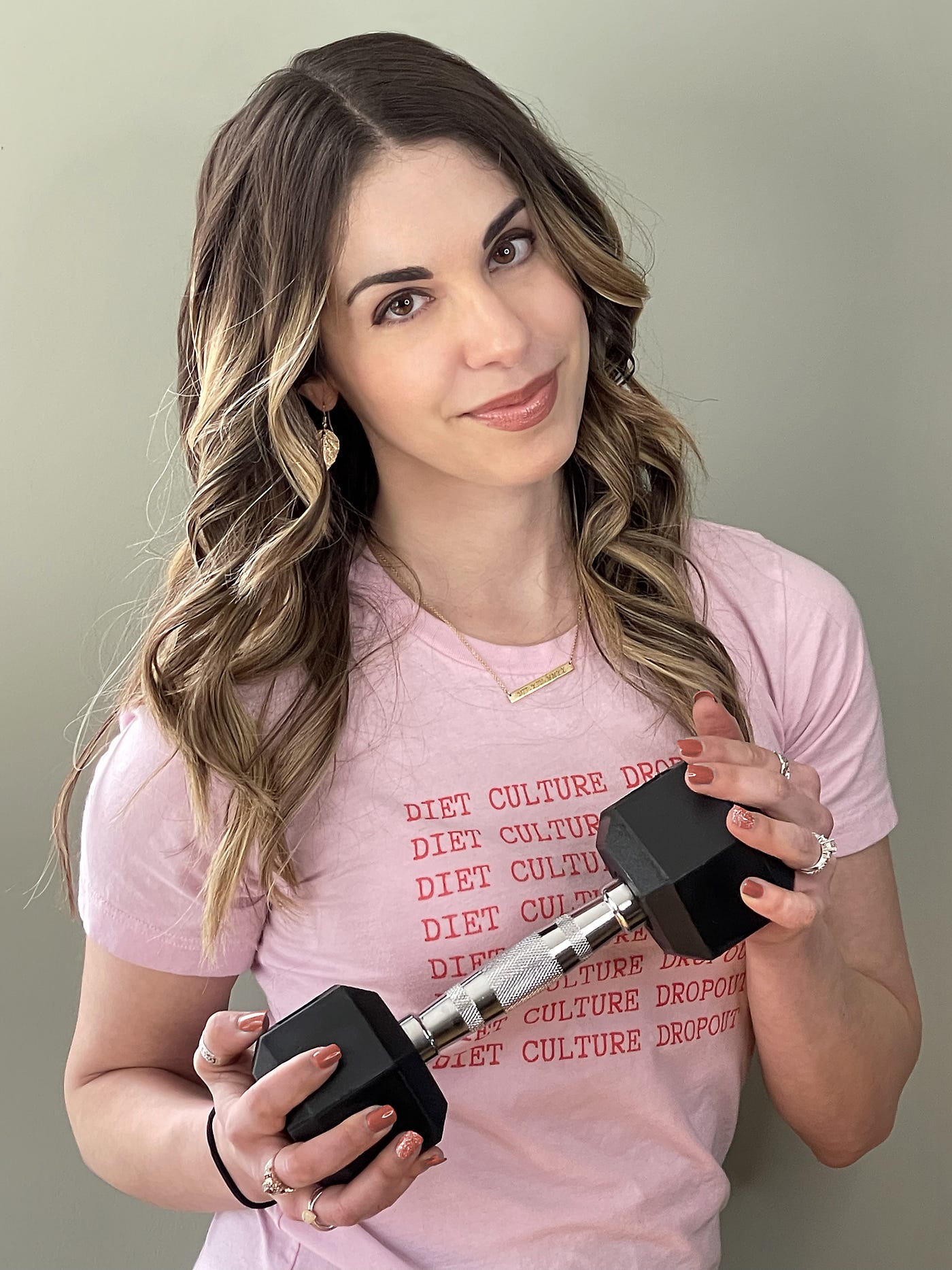
Alana Van Der Sluys is a Certified Intuitive Eating Counselor in training, an eating disorder survivor, and the founder of Freedom with Food and Fitness, an online community dedicated to empowering women to heal their relationship with food, weight, and their bodies through intuitive eating, fitness, and mindset coaching. She is also an award-winning, full-time English and journalism teacher in New Jersey. A lover of whisky and travel, Alana lives with her husband Scott; her son, Archer; and her fur baby, Captain Oats.
Thank you so much for joining us in this interview series! Before we dive into the main focus of our interview, our readers would love to “get to know you” a bit better. Can you tell us a bit about your childhood backstory?
I had a “typical” upbringing: loving parents in a small, rural New York town. I was always full of energy and joy, but also very responsible and conscientious. I thrived with structure and diligence and was successful in terms of extracurriculars and academics. I was often praised for my appearance and achievements, which drove me to continue to strive and challenge myself.
What or who inspired you to pursue your career? We’d love to hear the story.
Honestly, at first, no one but my own passions. I originally wanted to be a music journalist, and I didn’t know anyone personally who was a journalist. I just knew I loved to read, write, and listen to punk music as a teen. Once I realized that the life of a journalist didn’t mesh well with my structured personality, I searched for other avenues that would satisfy the writing and editing itch; for me, that was becoming a secondary English teacher. At the same time, I had a college professor who taught in the most mesmerizingly passionate way; I wanted to be able to make my passion for literature as contagious as he had, for students of my own.
When it comes to my intuitive eating coaching, I suffered from three eating disorders–orthorexia, binge eating disorder, and body dysmorphic disorder–for seven years in my 20s. Once I recovered, I wanted to take my passion for helping women with body image–along with my talent for teaching–and create my own business coaching women on intuitive eating, body image, fitness, and mindset work.
None of us can achieve success without some help along the way. Was there a particular person who you feel gave you the most help or encouragement to be who you are today? Can you share a story about that?
My parents always let me explore whatever my passions led. They never told me I couldn’t achieve something and were always financially supportive in terms of schooling when I was younger and dependent. My husband has been the same; even though we had a five-month old at the time of starting Freedom with Food and Fitness, he didn’t bat an eye when I said I wanted to create a side business. He knows I’m capable of anything I put my mind to and am passionate about any project I take on.
I also want to shout out the women who indirectly helped me recover, including the ladies of The Body Love Society, Caroline Dooner, Jessi Jean, Trish Blackwell, Evelyn Triboe, Elyse Reche, Christy Harrison, Brene Brown, and Brooke Castillo.
Can you share the funniest or most interesting mistake that occurred to you in the course of your career? What lesson or take away did you learn from that?
When I first started querying literary agents and book publishers for my first intuitive eating book, I had no idea what a book proposal or query letter was supposed to look like; so I was essentially sending out unformatted garbage that was probably getting sent straight to the trash folders of everyone they were sent to! Sometimes my ambition and excitement supersedes doing the work to make sure I am doing something correctly instead of quickly.
You are a successful leader. Which three character traits do you think were most instrumental to your success? Can you please share a story or example for each?
Thought work has been instrumental, and realizing that everything that happens in our lives–good and bad–is neutral until we make it mean something. All thoughts are choices. So I can choose to see failure as something to be avoided and choose to see my past failures as personal flaws, or I can see failure as inevitable to eventual success, as an opportunity to learn, get better, get stronger, and teach others how not to make those same mistakes.
Time blocking is crucial for me, as well. I can numb out by overworking and start attaching my worth to my productivity if I don’t manage it. I could spend hours on Instagram connecting with potential clients, but instead, I have two 10-minute blocks of time, everyday on my calendar, specifically for that task. After those blocks of time are completed and checked off my calendar, I do not open the app again for those reasons.
The last is my passion for learning. I am a “forever learner.” I don’t think we should stop learning until we die. There is always more knowledge and perspectives, more ways to improve and opportunities to challenge our minds to be better.
I’m an author and I believe that books have the power to change lives. Do you have a book in your life that impacted you and inspired you to be an effective leader? Can you share a story?
The book that inspired me to recover from my eating disorders and help other women to do the same is Evelyn Tribole and Elyse Resch’s Intuitive Eating. They are the founders of the anti-diet philosophy that changed my life. The book teaches people the myths around diets and body weight, while also helping to heal one’s self-worth and body image.
I also have to say, though, that this book ties with another: The Gifts of Imperfection by Brene Brown. She helped me to realize where my perfectionism– or “my 20 ton shield”-- came from, how it had served (or tried to serve) me, and how it is okay to let it go and replace it with authenticity and vulnerability.
What are some of the most interesting or exciting projects you are working on now? How do you think that might help people?
I just signed on with The Knight Agency for my first book about intuitive eating, fitness, mindset work, and body image. We are in the process of signing a contract with an international publisher. I have always been a writer so having a book published worldwide has always been a bucket list goal for me. I am also offering my first round of group coaching this summer for women looking to change their lives in terms of body image, mindset work, and intuitive eating.
OK, thank you for all of that. Let’s now shift to the core focus of our interview. This will be intuitive to you but it will be helpful to spell this out directly. Can you help explain to our readers why it is important to have a consistent morning routine?
It sets up the rest of your day. How you begin the day and the tone you begin it with set spills over; so if you have a morning routine that aligns with your intention for the day, your chances of having that day turn out the way you wanted to is much better.
Can you please share your optimal morning routine that can create a positive trajectory for a successful, effective, productive, and efficient day. If you can, please share some stories or examples.
I honestly think that an optimal morning routine begins at night. My nighttime routine sets up my morning routine. Each night, I set up my coffee pot, write down what I’m grateful for that day with the Grateful app, set out my and my son’s outfits, pack both of our meals and snacks, set my alarm for a time that will guarantee me at least seven hours of sleep, take melatonin, and clear my head with meditation. This makes my morning go much smoother. The first thing I do when I wake up is repeat the phrase, “I choose to make today great.” I know some will disagree with this, but I check my email first thing, just to make sure that there are no urgent “fires” to put out. I work out for 30-40 minutes, I drink my coffee while I get ready, I wake up my toddler and get him dressed for the day, I drive to work, and I have breakfast at school before the first bell.
Speaking in general, what is the best way to develop good habits? Conversely, how can one stop bad habits?
Labeling habits good and bad can be problematic; I think the intention behind your habits is more important. The fact I check my email first thing may be perceived by others as a bad habit, but I know I can better concentrate on my morning routine knowing nothing urgent has developed overnight.
Understanding why we perform habits is crucial. If I have a “bad habit” of numbing out with food to avoid negative emotions, I need to get down to the reason behind that habit. Perhaps I need better coping mechanisms or need to practice mindset work to process negative emotions. Once I understand what I really need instead of the food, I can make a plan to create habits that better serve me.
Doing something consistently “day in and day out” can be hard. Where did you get your motivation from? What do you use to motivate you now?
I have very clear goals for my life. I know where I want my business to be next year, I know how I want to feel about myself and my life, and I know what I want my work-life balance to look like. This keeps my “work time” efficient and separate from my “play time.”
What other resources would you suggest to our readers?
I would suggest getting a mindset coach such as myself. Not only does the mindset work that I teach my clients around food, weight, and their bodies apply to those things, but, quite literally, to all other areas of one’s life. Knowing how to manage your thoughts and emotions is the key to the universe.
Ok, we are nearly done. You are a person of great influence. If you could inspire a movement that would bring the most amount of good for the greatest number of people, what would that be? You never know what your idea can trigger.
I continually aspire to grow the anti-diet and body positivity movements. Millions of women (and men, too!) shrink themselves mentally, emotionally, and physically in order to fit an unattainable ideal. If these people could shift that brain power to something that would better serve them and the rest of the world, imagine what society would look like!
We are very blessed that some of the biggest names in Business, VC funding, Sports, and Entertainment read this column. Is there a person in the world, or in the US, whom you would love to have a private breakfast or lunch with, and why? He or she might just see this, especially if we both tag them :-)
I think I might faint if Brene Brown agreed to have breakfast or lunch with me. I’ve struggled my whole life with perfectionism, and I am continually in awe of her bravery, her raw vulnerability, how much she shared the times she “screwed up,” and her humor. I can bravely step into the messiness of who I am simply because she does the same and shares it with the world.
How can our readers further follow your work online?
I am on Instagram @FreedomwithFoodandFitness and at www. freedomwithfoodandfitness.com
Thank you for these really excellent insights, and we greatly appreciate the time you spent with this. We wish you continued success.
About the interviewer: Sara Connell is a bestselling author and the founder of Thought Leader Academy where she helps coaches, writers and entrepreneurs become best selling authors, TEDx and paid speakers. She has been featured on The Oprah Winfrey Show, Good Morning America, The View, FOX Chicago, NPR, Katie Couric and TEDx. Her writing has appeared in: The New York Times, Forbes, and many publications. Access her free masterclass: How to Write A Bestselling Book That Changes Lives (in less than 3 months) HERE