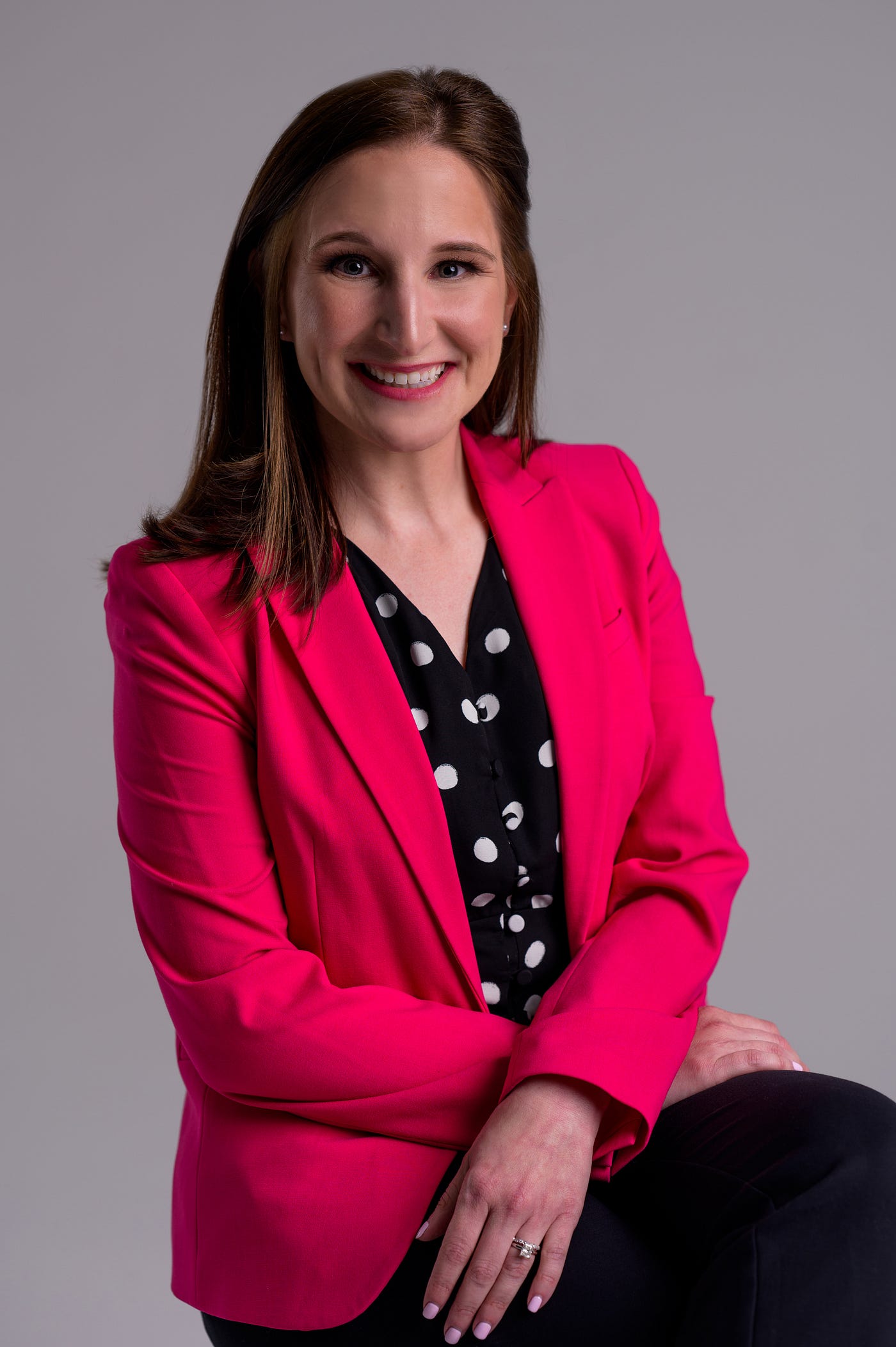
Had Josh waited to push me until I felt ready, I’d be sitting here years later, still creating stories for other people to tell, and instead, I get to teach a team of talented individuals to tell impactful stories to their clients.
Thriving As A Woman In a Male-Dominated Industry: (insertName & Company) On The Five Things You Need To Thrive and Succeed as a Woman In a Male-Dominated Industry
(If you are unable to download it, please click File-Download)
Please answer the questions, and leave the questions formatted as they are in the document. We may schedule a follow-up call or skype to round things out.
INTERVIEW QUESTIONS:
In the United States in 2022, fields such as Aircraft piloting, Agriculture, Architecture, Construction, Finance, and Information technology, are still male-dominated industries. For a woman who is working in a male-dominated environment, what exactly does it take to thrive and succeed? In this interview series, we are talking to successful women who work in a Male-Dominated Industry who can share their stories and experiences about navigating work and life as strong women in a male-dominated industry. As a part of this series, we had the distinct pleasure of interviewing Sarah Goss.
With a little Cajun spice and fire, Sarah brings over a decade of experience from Optum Advisory Services, Mental Health Cooperative, and The Advisory Board Company to the table. Her attention to detail and organization keeps our office rolling like a well-oiled machine. Sarah possesses a strong analytical mindset and has led teams to develop solutions for a wide variety of projects, ranging from redesigns of provider compensation plans to financial and operational assessments. Striving to ensure we “practice what we preach,” Sarah works closely with all team members to incorporate strong operational processes and encourages our team to think creatively and passionately about the solutions we build for our clients.
Before we dig in, our readers would like to get to know you a bit more. Can you tell us a bit about your childhood “backstory”?
I grew up in a small town in south Louisiana surrounded by family, where the women were blessed with great genes (I was the 5th generation first-born girl, and my great-great-grandmother lived until I was ~9). I was the stereotypical elder sister to one younger brother: “bossy,” perfectionist, rule-follower – traits that in my opinion have served me well as an adult.
I was a pretty studious kid and had a knack for both writing and math. While no one could ever accuse me of being athletic, I played the flute for about a decade, which takes an impressive amount of cardiovascular strength —or maybe I’m just trying to make myself feel better? My love for books started early (big shout out to the Pizza Hut summer reading programs of the 90s) and continues today.
Can you tell us the story about what led you to this particular career path- consulting?
During and after college, I worked for a large health system down in Louisiana, where I led the accounting/finance team that supported their employed medical group. Each month, I’d meet with the physicians to recap the prior month’s activity through the lens of their income statements. They’d have lots of questions about how they could “lose less money,” and I’d work with their administrators to identify opportunities to achieve that. We’d present those to physicians, and for the most part the response was, “yeah, okay thanks” without much action. Rinse and repeat every month for nearly two years. (In their defense, change is hard, particularly when their first priority needed to be providing excellent care to patients.) While I didn’t love the inertia, I really cherished the partnership with physicians, where I could bring my business expertise to their clinical world, and what better place to do that than in consulting (the airline / hotel status was great too)!
Can you share the most interesting story that happened to you since you began your career, whether at Ancore Health or a pivotal career point that got you to where you are now?
The most pivotal moment that comes to mind was about seven years ago. I built a presentation for a client meeting where our goal was to generate consensus about a compensation plan that could be used for both the academic and community physicians, who traditionally view the world – and how they get paid – in vastly different ways. Up until then I’d done a lot of deck building (what consultant hasn’t?!), but I hadn’t actually presented anything yet. I didn’t feel ready… I didn’t have the credentials to be viewed as the expert, and what if I disappointed the project lead, who was also my people manager and mentor? Or worse, what if the entire project imploded because I said the wrong thing?!
I spent days on this deliverable: crafting the right message, highlighting where there was already agreement, and pushing the envelope where it mattered – all in the name of getting everyone to give a little. So, I’m on the plane to the presentation meeting when my project lead (and mentor), Josh W., asked if I was satisfied with the work… I said yes – I really was. Then he did the most heinous thing (or so I thought at the time): he said I had to give the presentation. WHAT?! Was he kidding… I was a wreck, but he didn’t give in to my pleas for more prep time. So, I did it, and it went great. The physicians were engaged, appreciated my thoughtful-yet-direct approach, and ultimately agreed upon a formula that was fair and financially sustainable. Had Josh waited to push me until I felt ready, I’d be sitting here years later, still creating stories for other people to tell, and instead, I get to teach a team of talented individuals to tell impactful stories to their clients. I can draw a direct line from the confidence he showed in me that day to what I’ve accomplished in all the years since.
You are a successful business leader. Which three character traits do you think were most instrumental to your success in consulting? Can you please share a story or example for each?
1. I am authentic: I don’t put on a front. Ever. For any reason. My actions, reactions, thoughts, and feelings are all happening in real time, usually for better or worse written across my face, and I own them. If I’m excited, I don’t think twice before bouncing around the office, interrupting others’ trains of thought to share the good news. Just like I don’t flinch when someone (or I) drops a well-placed four-letter word in conversation, even if it’s not “professional” or “lady like.”.
2. I pride myself on being humbly confident: It’s cliché because it’s true: if you don’t believe in yourself, why would anyone else… especially someone paying good money for your knowledge or skill? The key here, though, is being confident in areas that I am confident in. What I mean by that is, authentic confidence is the gold standard. I shouldn’t project confidence about my personal ability to code up a database (our data scientist would agree), but I should convey confidence that I can design a reporting system to meet the needs of many stakeholders because I can and do. I’m more comfortable and better able to talk about things I know well, so I lean into that without feeling the need to be a know-it-all… because I don’t know it all.
3. I strive to be vulnerable: In an industry that exists solely for experts to solve problems, I find it really freeing to admit when I didn’t know something. That seemed so counterintuitive earlier in my consulting career, but it has earned me so much trust and respect from teammates, bosses, employees, and even clients because they all knew that when I was speaking authoritatively about a topic, there was no bullshit (can I say that here?!) or bluster.
I wouldn’t be a good consultant if I didn’t remind you that, while these seem universal to me, my three most impactful character traits may be different from yours. That’s fine. There’s no handbook for this, and anyone who tells you otherwise is peddling crap. You make it up as you go, pivoting until you find what fits you best.
Let’s jump to the primary focus of our interview. Can you help articulate a few of the biggest obstacles or challenges you’ve had to overcome while working in a male-dominated industry?
In hindsight it seems so simple… the biggest challenge I had to overcome was speaking loudly enough to be heard, and I mean that in the purest sense. Excuse the overgeneralization, but male voices tend to be deeper and carry farther. If I wanted my perspective out on the table, I had to talk louder.
Another obstacle I overcame was my tendency to be deferential and overly helpful – not only to men but to people of authority in general – blame my southern upbringing for that… This manifested itself in ways that I honestly didn’t even notice, like letting everyone else have the seats around the conference room table while I sat in a chair along the wall or constantly offering to take notes in meetings. I saw this as being kind (it was?), and it was also keeping me from being a part of the conversation. I probably would’ve done this forever had it not been for an intentionally empowering practice lead: Michele M. Michele and I were at dinner one evening in Tampa, FL after a client meeting when she pointed out my habit and gave me a piece of advice that I’ve carried with me ever since: no matter what, always sit at the table. My male colleagues weren’t asking if it was okay – they asked for forgiveness later, if at all.
I’ll always be grateful to Michele who also helped me break another horrible habit. Anytime I had what I considered to be a “hard question,” I’d start by apologizing for it, hoping to stave off any offense I might cause or to spare myself the embarrassment if it actually wasn’t a difficult question: “guys, I’m sorry for this, but have we considered ____?” Every. Single. Time. One afternoon, after we finished ripping apart an excel model, Michele asked me to hang back and told me what I was doing. Without any fear of my feelings, she very bluntly told me to stop apologizing because I was eroding my own confidence by qualifying my questions or insights, that my input was both wanted and valued. She said she understood that it was a habit I had to break and committed to helping me do it. So, every time she caught me starting down that path, she’d gently interrupt me by saying my name, and I’d start again – only this time without the apology. (Did you notice that I actually did it earlier in this interview?! Ahh!)
What Michele didn’t know was that her directness unleashed the same in me. Her radical candor (excellent book!) ensured that nothing was lost in translation, and I respected her immensely for her willingness and ability to do that for me. It’s been a few years since I’ve worked with her, but I’ve never forgotten how good it felt to not have my feelings managed. My team would tell you that it’s how I approach each and every conversation I have with them. Of course, I sometimes question if that philosophy is best, and I’m not everyone’s cup of tea (I prefer coffee anyway). But I’ve been pleasantly surprised by my team’s feedback that I’m “firm but fair.” Can’t ask for much more… so, I keep on keeping on.
Can you share a few of the things you have done to gain acceptance among your male peers and the general work community? What did your female co-workers do? Can you share some stories or examples?
To be honest, I don’t know that I did anything specifically to gain acceptance. I worked hard and helped others, but so did my male colleagues. That could very well be because consulting lends itself to being ‘in the trenches’ with your team, building trust through shared experiences. Nothing fosters comradery better than a couple of all nighters to pull off a big deliverable. Of course, professional services can sometimes be a breeding ground for competition and does have an earned reputation for being a bit cutthroat, but I was lucky to have bosses that were careful to protect the culture of our team. They preached to our clients that “a rising tide lifts all boats” and then lived that out themselves.
What do you think male-oriented organizations can do to enhance their recruiting efforts to attract more women?
Provide flexibility for changing personal priorities. When I first came to consulting, I was in my late-20s, single, with no kids or pets, so I had no issues with hopping on a plane every week, sometimes crisscrossing the country twice a week, or working late into the evening to meet an important deadline. It was fun, partially because I had no one that needed my physical, mental, or emotional presence. The reason I left consulting after 6 years was because I met my now-husband, and the road-warrior life wasn’t conducive to building the relationship I wanted to have. I didn’t see a path to continued success and upward mobility when that depended on living out of a suitcase. Keep in mind that this was all pre-pandemic when you partially proved your value to clients by showing your face (even if 100% of your work could be done remotely).
I came back to consulting at Ancore Health because our CEO, Eric Passon, thinks differently. He walked away from the road-warrior life to create a company that focuses on solving our clients’ most challenging issues in a way that doesn’t burn out our #1 asset: our team. Even before the pandemic, this was a big differentiator because it just wasn’t done that way… Ancore’s clients appreciated that we weren’t racking up thousands of dollars in travel expenses for work that could be done remotely, and our team loved that they didn’t have to sacrifice picking up their kid from daycare every day or could sleep in their own beds every night (IYKYK).
Here is the main question of our interview. Based on your opinion and experience, what are the “Five Things You Need To Thrive and Succeed as a Woman In a Male-Dominated Industry?” (Please share a story or example for each.)
Self-awareness – you have to simultaneously know what you know and what you don’t know. This allows you to have confidence where you excel and to surround yourself with people who can support the areas that aren’t your strongest.
An advocate – someone who will authentically go to bat for you, ensuring that they’re taking you along with them. I’ve been fortunate enough to have several of these people throughout my career, who spoke highly of me even and especially when I wasn’t in the room, and it meant that important people knew my name and the good work I had done.
A mirror in the form of a person – this person tells you the cold hard truth, even if it’s hard to hear… especially when it’s hard to hear. Was it pleasant to hear that I apologized too much? Of course – it felt like a fatal character flaw to not be taken seriously, but without Michelle, I’d probably still be “I’m sorry”-ing my way through meetings. You have to have people who care enough about you to be radically candid with you. (I really loved that book, didn’t I?)
A mentee – whether formal or informal, you should absolutely pay it forward. Make space for another woman. Be their sounding board. Offer them advice. Introduce them to important people. PAY IT FORWARD. Beyond all that it will do for them, it feels good to help someone else.
A carry-on suitcase – like it or not, few things give off the vibe of being high maintenance (even if you’re not) than needing to wait for a checked bag while all the men are impatiently hmph’ing because they didn’t build in the extra 20 minutes into the timeline for that. If they think you’re high maintenance, they’ll treat you like you’re high maintenance. (I recognize that’s not the most female empowerment thing I could’ve put on this list, but why make it harder for ourselves when packing efficiently is a very valuable skill.)
If you had a close woman friend who came to you with a choice of entering a field that is male-dominated or female-dominated, what would you advise her? Would you advise a woman friend to start a career in a field or industry that’s traditionally been mostly men? Can you explain what you mean?
For those who are privileged enough to have a choice, my advice would be to pick whatever path allows them to be their most authentic selves. If they are natural care takers and are deeply empathetic and sensitive (in all the best ways), then it might be too emotionally taxing to be in an environment where feelings are not a top priority. Personally, I think careers are a bit like the Sorting Hat in Harry Potter — understanding who you are, your non-negotiables, passions, and skills, your ideal life/work balance, etc. will guide your inner Sorting Hat to the field where you can be yourself and do your best life’s work.
To a female friend wanting to start a career in a field or industry that has been historically dominated by men, I’ll paraphrase Elizabeth Gilbert: don’t put your wishbone where your backbone should be. You have to really understand what you’re signing up for and not waste a bunch of time wishing it was different. Work hard, set boundaries, ask for help, know your worth, and use that backbone to advocate for yourself and others.
Have you seen things change for women working in male-dominated industries, over the past ten years? How do you anticipate that it might improve in the future? Can you please explain what you mean?
It’s absolutely changed. The most impactful change I’ve noticed is women are elevating women. Whether intentionally or not, there was some gatekeeping… if only one woman was “allowed in,” then who would give that chance to someone else?! But now that we’ve made space for ourselves, the women I’ve had the pleasure to know subscribe to the more the merrier approach and actively seek out opportunities to pull others along.
I think we’ll continue to see more and more women in male-dominated industries as gender norms at home continue to evolve and as we as a society change our views on the roles women should play. We’re already more accepting of people choosing to live differently (kids, no kids, single, married, committed partnership, etc.), and my hope is that companies will continue to find value in being flexible so people can bring their whole selves to work.
We are very lucky that some very prominent names in Business, VC funding, Sports, and Entertainment read this column. Is there a person in the world, or in the US with whom you would love to have a private breakfast or lunch with, and why? He or she might just see this if we tag them…
This question was the hardest for me because I felt pressure to have a profound reason for wanting to meet someone. Should I choose Hillary Clinton for all the barriers she’s broken for women through sheer grit and determination? What about Oprah Winfrey, who built an empire long before women thought that was possible? Dolly Parton, Michelle Obama, Taylor Swift, Robin Roberts, Reese Witherspoon? My list is so long… but since I can only pick one — I’d love to have breakfast or lunch with Abby Jimenez. There are few authors that I have google alerts for even a whiff of a new release coming in a year, but she’s absolutely on that list. Her stories have made me laugh and cry… I’ve been angry and empowered… I truly just love her.
In a moment of raw transparency, as I was thinking about your questions, I wondered if I was the right person to give this interview. I’m privileged (and grateful) that my experience wasn’t traumatic or dramatic and didn’t require some superhuman effort or skill to be successful in a male-dominated industry. It was a lot of hard work, a dash of right place/right time, and accepting mentorship and advice from both men and women alike. Then I thought it was just as important to highlight that the deck isn’t always stacked against you… Sometimes, you do get lucky.
Thank you for these fantastic insights. We greatly appreciate the time you spent on this.
About The Interviewer: Kelly Reeves is a published writer, copy editor, speaker, and certified entrepreneurship and personal growth coach. She is passionate about working with entrepreneurs and executives over 50 to help them discover their life’s purpose, unlock their full potential, and thrive in the second half of life. As an award-winning public relations professional with multi-industry knowledge Kelly worked with global brands, startups and media personalities including the Tony Hawk Foundation, Barrett-Jackson, Targus, Kingston, WD, and Howard Stern. Kelly successfully launched a variety of consumer electronics and B2B brands and executed highly successful PR and social media campaigns. With an average track record of generating more than 50 million media impressions on a monthly basis, she placed clients in leading media outlets such as InStyle, the Wall Street Journal, USA Today, CNet, TechCrunch, AllThingsD and Mashable; and landed spots on high profile programs such as Extra, the Today Show, ABC News, CNN and Good Morning America. She also played an integral role in helping clients increase sales revenue by over 350%. Her community service includes mentoring students in the Masters of Entrepreneurship Program at the Paul Merage School of Business at the University of California, Irvine. She also mentors students in the College of Communications at California State University, Fullerton. Kelly serves as the Co-Founder and President of Paw Prints in the Sand Animal Rescue, a 501c3 animal welfare organization where she oversees the operations, donor relations, and marketing and PR strategy.