The ultra-confidential world of high jewelry is run by capitalists and investors, the same leaders who are trusted with taking our industry forward, but they fail.
Business
Sally Skoufis: How Disrupting Traditional Luxury Jewelry Supply Chains Restores Environmental Balance
Jewelry designer and founder Sally Skoufis shares how her brand challenges industry norms by integrating sustainable circular economics into high-end design.
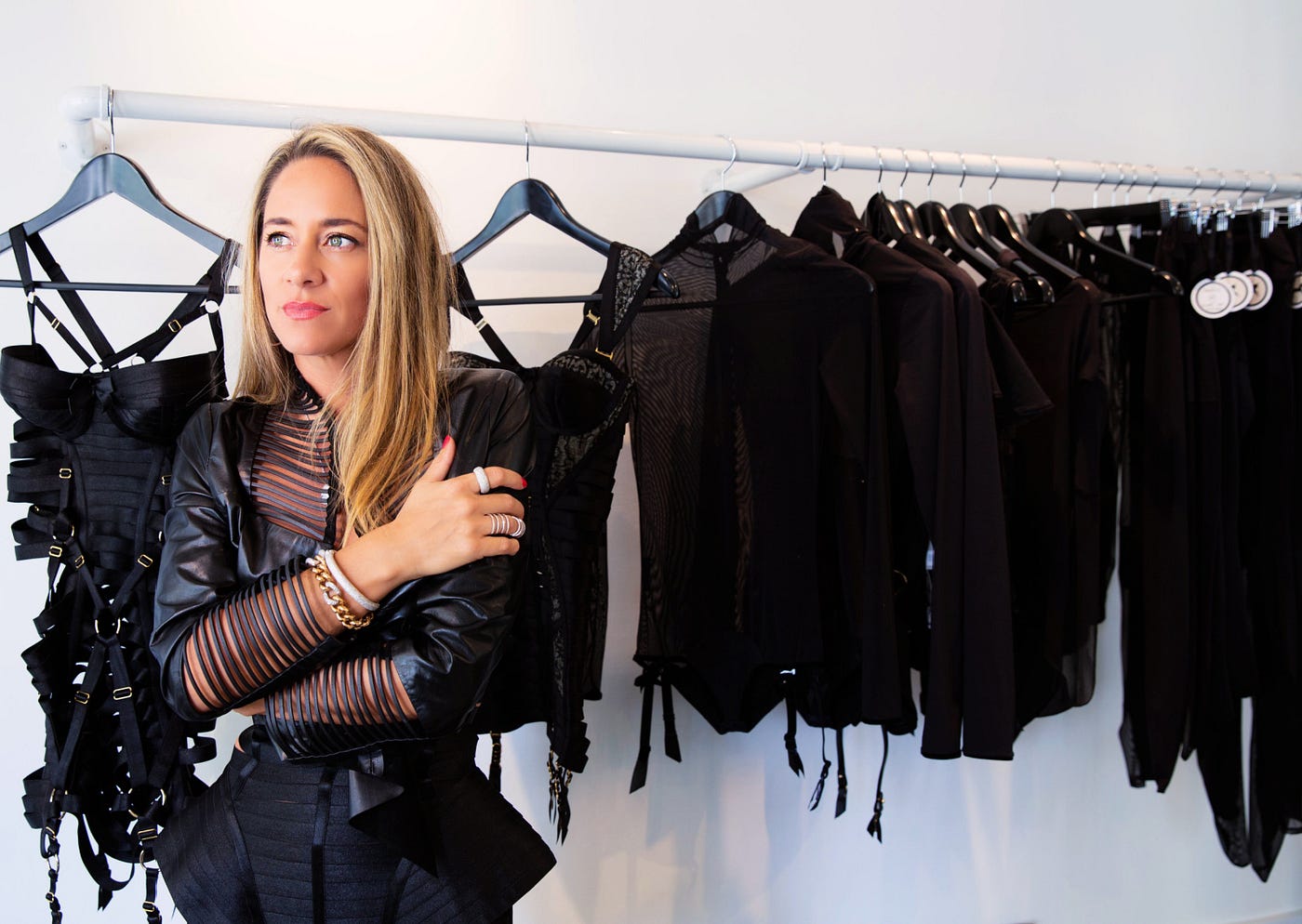
As a part of our series about women who are shaking things up in their industry, I had the pleasure of interviewing Sally Skoufis.
Hailed as a tastemaker in design and a lover of understated luxury, her desire for adornment and her innate nature of sharing with the women who inspire her is embedded in every piece of jewelry she creates under her eponymous brand SALLY SKOUFIS. From runways at New York Fashion Week to Paris, influential women around the globe are proudly wearing Sally’s unique pieces as a symbol of display of their individuality, femininity, and allure.
Thank you so much for doing this with us! Before we dig in, our readers would like to get to know you a bit more. Can you tell us a bit about your “backstory”? What led you to this career path?
My parents were academics. As such, they encouraged me to examine life from many different lenses. I came of age in a constant state of inquiry and curiosity, never accepting anything at face value. Encouraged to probe the world on my terms, I built a foundation of courage and conviction, which I’ve relied on ever since.
I couldn’t relate to the rote learning model at school. As an early conceptual thinker with an entrepreneurial spirit, I was eager to apply my ideas. By the time I was in middle school, I’d seeded several business concepts. With impatience and big dreams, I voluntarily dropped out of high school, ready to take on the world.
A fascination for gems, jewelry, and glamour was etched in my soul. I completed a silversmith course and started developing relationships with global gemstone suppliers while working in fashion. A minor miracle, I was accepted as a mature-age student into a leading Australian university. While there, I completed a double degree in Arts and Commerce and sold jewelry to fund this education.
Later, I was invited into an international collegiate honor society for reaching the top academic percentile in Australia. I felt validated, perhaps since I’d ticked the “expectation” box, but also since I’d finally been shown — by real industry insiders with experience in finance and economics — how to transfer my style of applied learning to big picture ideas.
After reaching corporate career highs, I finally started my own business and felt true validation — a validation that came from the inside, through complete personal alignment. I’d abandoned the yellow brick road and finally connected my creative spirit to a core purpose.
What followed was two years of research and development, where my design prototypes were manufactured worldwide, manifesting my vision of an entirely new form of jewelry. I spent most of this time rejecting samples, yet recall like yesterday when a team of incredibly gifted artisans revealed their work, I felt a whole-body exhilaration and soul-level validation. I was on my path. And I’d found my tribe.
In Singapore, after 20 years of commercial expertise and global marketplace savvy, I was able to discern our biggest mission; to defy the status quo and create a whole new paradigm of jewelry. This was to be the exception to an industry dominated by megabrands and chains with heavyweight finance.
That mission led me to open runway shows, create custom pieces for A-list celebrities, and grace many top tier publications. Intention and creativity are super powerful. My success was not accidental. It was intentional, strategic, and highly planned.
I’m very proud to have successfully scaled without compromising creativity, materiality, manufacturing practices. Most importantly, my sense of self as a Founder.
As a Founder, I have no temperament for an ordinary world or customary way of life. I challenge everything with conviction and leave no room for people or things without soul. I’m unapologetic. People say I live in my dimension apart from the everyday world. I would agree. It’s the place where great art comes from.
Can you tell our readers what it is about the work you’re doing that’s disruptive?
I created a marketplace offering that did not exist. My design signature is to embed a single black diamond and incorporate conscious materials as a mark of time, environmental necessity, and a provocative symbol of change. Every choice I make is intentional, paying homage to luxury while graciously raising a middle finger to its capitalist backbone.
The ultra-confidential world of high jewelry is run by capitalists and investors, the same leaders who are trusted with taking our industry forward, but they fail. In a world where the cacophony of noise around social and environmental issues is deafening, there is silence from my industry. Instead, they pride themselves on ever-growing profits, because in their view, that’s what businesses are supposed to do.
This march towards extreme profit does not consider the human or environmental cost. As I see it, the ideal business of the future will make profits but sustainably, through circular economic modelling, which contributes genuine profit into a cause. They’ll be forced to be honest with their customers. This is a disruption to their arcane practices.
In 1940 during World War II, in a failing luxury market, and with 90% control of the world’s diamond production at the time, De Beers intentionally created market demand by turning a diamond into a psychological necessity with its famous “a diamond is forever” campaign. At the time, only 10% of engagement rings contained diamonds.
With a strategy to manipulate consumer demand by changing Americans’ social attitudes, they convinced people that marriage isn’t complete without a diamond ring. With an expensive marketing campaign, they increased that number to 80%. De Beers sales grew 91x by 1980, on to a market value of 79B USD today.
Those same decades saw exponential devastation to the environment and humanity, and by 1990 these precious gems were classified as “conflict diamonds” or “blood diamonds” by the United Nations. This classification symbolized the irresponsible mining and brutal civil wars in Africa because of this artificial demand and market domination.
Irreversible environmental damage due to poor planning and weak regulation in the industry severely damages our land and water. In extreme cases, diamond mining can cause entire ecosystems to collapse, forcing communities to relocate. This is a conversation we need to have and a truth that needs to be broadcasted.
The disruption I seek comes from the heart but is also a necessity. Global market dynamics must change. My designs carry a single black diamond not only for their aesthetic and access to luxury but for the message of impact they have.
I source non-commercial natural diamonds deemed unworthy to these giants. I use the HPHT method (high pressure, high temperature) that replicates the natural process in which a diamond is created below the earth’s crust to turn them black.
I’m proud to contribute 100% of their value back to the environment and communities that the capitalist model has destroyed. Moreover, my white diamonds are hand-made — beautifully indistinguishable and identical to mined diamonds, but without social and environmental destruction. I believe that when potential buyers of my jewelry understand the value, standards, thought, and conscience of my design ethos, they will forever change their view of global brands and what jewelry is supposed to mean.
It’s time for a new frontier, and I’m a proud pioneer, driving change and the type of circular economy required to restore balance and repair environmental and human damage. This can only be achieved through collective participation, cohesion, innovation, strategy, and thought leadership within the industry. I play the role of a social provocateur. I facilitate disruption in the form of honesty. I empower modern women with the knowledge that helps them make conscious, informed decisions.
Can you share a story about the funniest mistake you made when you were first starting? Can you tell us what lesson you learned from that?
Not funny per se, but after launching in Australia, their largest department store, Myer, invited me to meet to discuss a new vision to support Australian ‘wanted brands’. I was offered a place amongst 6 other jewelry houses in a marquee store “pop-up” event. I politely declined, stating that when ready to implement their new company vision rollout, I felt a greater brand alignment to partner then.
That decision could have cost me the account entirely, but I believed in my brand value, and holding out was a risk I was prepared to take. That conviction paid off. Myer immediately committed to launching my brand nationally and invested in its success. I also showcased it at the pop-up!
After 7 years, I am humbled and very fortunate to still be part of Australia’s most iconic retailer. I get excited every time I see my local line outselling the international brands. I am proof they have a solid dedication to independent brands and serving the needs of Australian women.
We all need a little help along the journey. Who have been some of your mentors? Can you share a story about how they made an impact?
On a flight, I stumbled across a video of Steve Jobs reciting the Jack Kerouac piece “Here’s to the crazy ones” about how the drive of the seeker and visionary is often met with judgment. It hit me to the core.
Likewise, I’ve always sought my own road, defying rules and norms. This aversion to conformity also comes with a price: isolation and confrontation, especially in Australia, where the culture cuts down the tall poppies.
Steve’s recitation reignited the passion necessary at a critical axis point in my life. It affirmed and validated the “misfit” person I am and renewed my faith that I was part of a unique collective. I’ve never doubted or looked back since.
Whatever I’ve needed has always been provided with divine timing. Field experts, creatives, thought leaders and brilliant minds have appeared in magically serendipitous ways with a frequency and synergy too striking to ever question. Their collective impact on me is the gift of feeling aligned, complete faith I am doing the right thing, at the right time, in the right place, with the right people.
In today’s parlance, being disruptive is usually a positive adjective. But is disrupting always good? When do we say the converse that a system or structure has ‘withstood the test of time’? Can you articulate to our readers when disrupting an industry is positive and when disrupting an industry is ‘not so positive’? Can you share some examples of what you mean?
It seems organizations have a choice; to leverage disruptive, exponential change to generate a new kind of value … or fail.
It’s not that black and white. I believe all successful businesses have a culture of “continual disruption” where they continually question everything. They question what they are doing, why they are doing it, and consider how they can do things differently. By continually challenging the norms, these businesses often drive whole sectors forward.
The word “disruptive” is commonly misunderstood. “Disruption” suggests more like a hand-grenade approach: in the same way, it works successfully, it more often fails. The problem is that we only hear of famous disruptors who succeeded, so we falsely assume all disruption leads to winning. What’s worse is that some people know better but then idolize disruption — a kind of culturally approved cognitive dissonance. This insistence fetishizes “being disruptive” and creates a gung-ho attitude absent of critical thought and responsibility. Disruptive action will have consequences, and some will be unintended consequences. That’s not sexy, but it’s the truth.
“Disruptive” is too harsh of a word to describe the kind of businesses and change agents I am advocating for. The word has also been entirely appropriated by the worst edges of Capitalism. It’s been weaponized to indoctrinate people to value visible monetary gain only.
Let’s please go ahead and retire “disruption” and “disruptors.” Let’s resuscitate “innovation” and “innovators.” Sure, these words are not as edgy, but they’re accurate. Being authentic is potent, and honest businesses change the world by nudging forward each day. They get better, step-by-step, on a granular level.
Customers affirm these changes every time they spend. With better regulation and greater accountability, businesses will not need to continuously be “disruptive” in such a brutal way or at all. Their “innovation” could be more organic and collaborative, where businesses creatively align to diminish our various collective crises.
When capitalist values govern a primary sector and raw materials, it is never good. There are countless examples in every industry, especially food and fashion. The jewelry industry is massive and valued at USD 266.53 billion in 2020, with a ‘deal value’ 20x larger than fashion. What’s ‘on trend’ are large jewelry houses growing market share by acquiring local players. This dilutes the marketplace of its uniqueness. Its strangled competition, leaving it as cost and scale-prohibitive for independent brands to innovate and push boundaries.
In my view, the “not so positive” is the loss of access. Say goodbye to diverse ranges of adornment and the divine feeling of connecting with your unique piece. There is a loss of access to the history the piece holds and its emotional complexity. As large brands pay no attention to history or connection, we also lose priceless stories, artisanal methods, and meaning especially ancient ones. If these are lost, the big brands win, and all of us lose. We’d be forced to conform to their aesthetic tyranny while simultaneously destroying our planet with our complacency and cowardice.
Negative environmental and human impact is real. That’s the real “disruption”, and it is not good. Given my commitment to positive social and ecological change, I find it curious that my intentions are labelled “disruptive.” Fine. I’ll play along if it helps my purposes more than theirs. Call it what you want. But I am putting my energy into positive, continual innovation. I am here to turn business models upside-down, destroy legacy value, and open revolutionary possibilities.
Can you share 3 of the best words of advice you’ve gotten along your journey? Please give a story or example for each.
1. “Reach for the stars, perchance you might achieve.” My father is animated when he shares this because his father shared it with him, and his grandfather with his father, and so on. My family freely permitted me to dream big and consider infinite possibilities. I took this sentiment and ran with it.
2. “Believe It or Not” the theme song to The Greatest American Hero. When I first heard this, it hit me and stuck. I find myself singing it spontaneously while walking down corporate corridors, in moments of awe and wonder, when I’ve had an awakening or big news, and an aliveness pervades my body — as if its atoms are dancing. The words always seemed to narrate my journey. With humble beginnings, I endured sacrifices to get where I am. When I feel uplifted, this song connects me to a feeling of immense gratitude and a genuinely expansive, freeing sensation. Reminding me everything is possible.
3. I’d like to suggest a third. Our most iconic global brand proposition to date has been an invitation to Just “Do” It. And the western world has been “doing” for a long time, granted it’s taken us far. Yet, it’s time we come home to ourselves. To Just “Be” It.
To experience a deeper dimension to life other than identifying with lack, anxiety, fear, reputation, and money to motivate our external desire to ‘do’, act, think, react. A perpetual cycle of egoic gratification that can never be topically satisfied.
It’s time we regain a sense of presence. To awaken to a deeper self, a ‘beingness.’ As it’s only in this realm of consciousness, one can truly discover the essence of who they are. A place where deep, wholehearted contentment, and ascension from an external ‘need’, can be found. Just in being.
We are sure you aren’t done. How are you going to shake things up next?
I’d like to sit down with Oprah. Almost everything I’ve ever visualized has materialized, so my approach is to focus energy on “what” I’d like to achieve, with complete faith that the “how” will take care of itself.
As for the rest of my plans, that’s a secret for now.
In your opinion, what are the biggest challenges faced by ‘women disruptors’ that aren’t typically faced by their male counterparts?
Relative to my world, it’s male-dominated by some significant heavyweights, yet it’s also a woman’s domain. This appears like a challenge, but I see it as an opportunity.
I’m at the frontier of a new world order and am very happy provoking important discussions. With my cohort of male and female innovators, our focus is on the need for change, irrespective of traditional constructs and the sex of those in power.
Humanity is waking up and reassessing its values. People are paying attention, and the real story of what is underneath commercial giants is becoming transparent and undeniable.
By accepting capital injection, I’ve seen too many brands dance with the devil and get stripped of their heritage and identity. More money usually means creative dilution and demise. This is why I rejected equity funding multiple times.
I grew up with two older brothers. Whatever they could do, I could do better, or at least that’s how I saw it. This perception fashioned me to be bold, courageous, and strong — inside and out.
My brand draws on this as a voice for female warrior souls: awakened, centred, discerning, authentic, and purposeful. A gorgeous tapestry of a female psyche. So, I see myself in a far better position to adorn women than men.
It’s interesting. Connecting with my clientele authentically, feeling into her soul, and serving her honestly is now called “disruption.”
Do you have a book/podcast/talk that’s had a deep impact on your thinking? Can you share a story with us?
There are too many stacked next to my bed to list! Here are a few I’m juggling:
Women Who Run with the Wolves by Clarissa Pinkola (inspires my soul)
Cosmos by Carl Sagan (inspires my mind)
The Hidden Half of Nature, the Microbial Roots of Life and Health by David R. Montgomery & Anne Biklé (inspires my heart)
I’m currently thinking about how the oil painting technique known as Chiaroscuro applies to life. “Chiaro” is Italian for clear/bright, and “scuro” is dark/obscure. Da Vinci popularized this Renaissance “shadow-painting” technique.
As the saying goes, “the brighter the light, the darker the shadow.” I love to apply this fascinating paradox, our most natural reality, into my work. I’m not always “on” and bright. In fact, it’s my darkest moments that give me the greatest enlightenment. And I express this profound truth through adornment.
I hope the divine beauty our early art masters saw is never lost. As living examples of Chiaroscuro, we embrace honesty and make authentic statements. If we lose this contrast, we lose the beauty and lose ourselves. After all, she is rare because she is real.
You are a person of great influence. If you could inspire a movement that would bring the most amount of good to the most amount of people, what would that be? You never know what your idea can trigger.
Let’s rethink the way to adorn from the ground up since the top-down continues to fail. There are two major jewelry players: Fine or Fashion. Fine jewelry uses precious metals and stones with inflated price models. Fashion jewelry uses alloys, synthetics, and machine mass production. The dominance of these two is destroying lives and our environment.
Large jewelry houses grow market share by acquiring local players, which dilutes brand essence and differentiation. They monopolize and manipulate us with “go-to-market strategies” from a capitalist playbook. If we’re to maintain freedom in personal expression and stay connected and accountable for our planet, this pattern must stop. Let’s establish a new pattern; adornment with a social presence, honest about how it is made, how it is sold, and where it sold.
“Celebrating the empowerment of a free-spirited individual,
I create jewelry that calls for connection.”
I chose to be a beacon within a tired category. Let’s start a new wave that shakes off those old jewelry houses and bad costume jewelry on carousel displays. Ours is fine material quality with intentional design.
We’re all responsible for our purchase decisions. The movement I seek is for my tribe to know the real story emotionally and value that connection. In doing so, men and women become part of an exclusive yet inclusive group. They connect to the moment jewelry was birthed, the memories it holds, the memories it will create, and the transformation it inspires.
Radical change is required, and I call on my global tribe of warrior souls to drive this change since they are the key bearers of our future. Otherwise, all that we’ll be left with are wastelands; a few global players holding inequitable wealth and power, delivering us homogenized marketing with uninspired design at an immeasurable cost to humanity and our planet.
Can you please give us your favorite “Life Lesson Quote”? Can you share how that was relevant to you in your life?
I wrote a poem at one of the most transformative moments in my life. Life’s lessons distil what you’ve learned into a personal philosophy. This poem titled ‘Warrior Soul’ is the most fitting expression of mine. You can experience it here: www.sallyskoufis.com/warriorsoul
How can our readers follow you online?
You can follow me on Instagram @sallyskoufis, and Facebook @sallyskoufisjewelry
You can view my creations at www.sallyskoufis.com
This was very inspiring. Thank you so much for joining us!
CG
Written by
Candice Georgiadis
Editor & Journalist · Authority MagazineCandice Georgiadis is a senior columnist at Authority Magazine covering Business and Tech, conducting primary-source Q&A interviews with founders, executives, and industry leaders.

Published inAuthority MagazineTop Lessons, Top Authorities · 42K Followers
Exclusive, curated interviews with the leaders and changemakers shaping tomorrow. Leadership lessons, industry deep dives, and executive profiles.