Early on at The Roderick Group, things were hard often. Access to capital proved to be the biggest hurdle. Most banks wanted significant collateral to extend a line of credit and no one was lending money due to the 2008 financial crisis.
Short Bio:
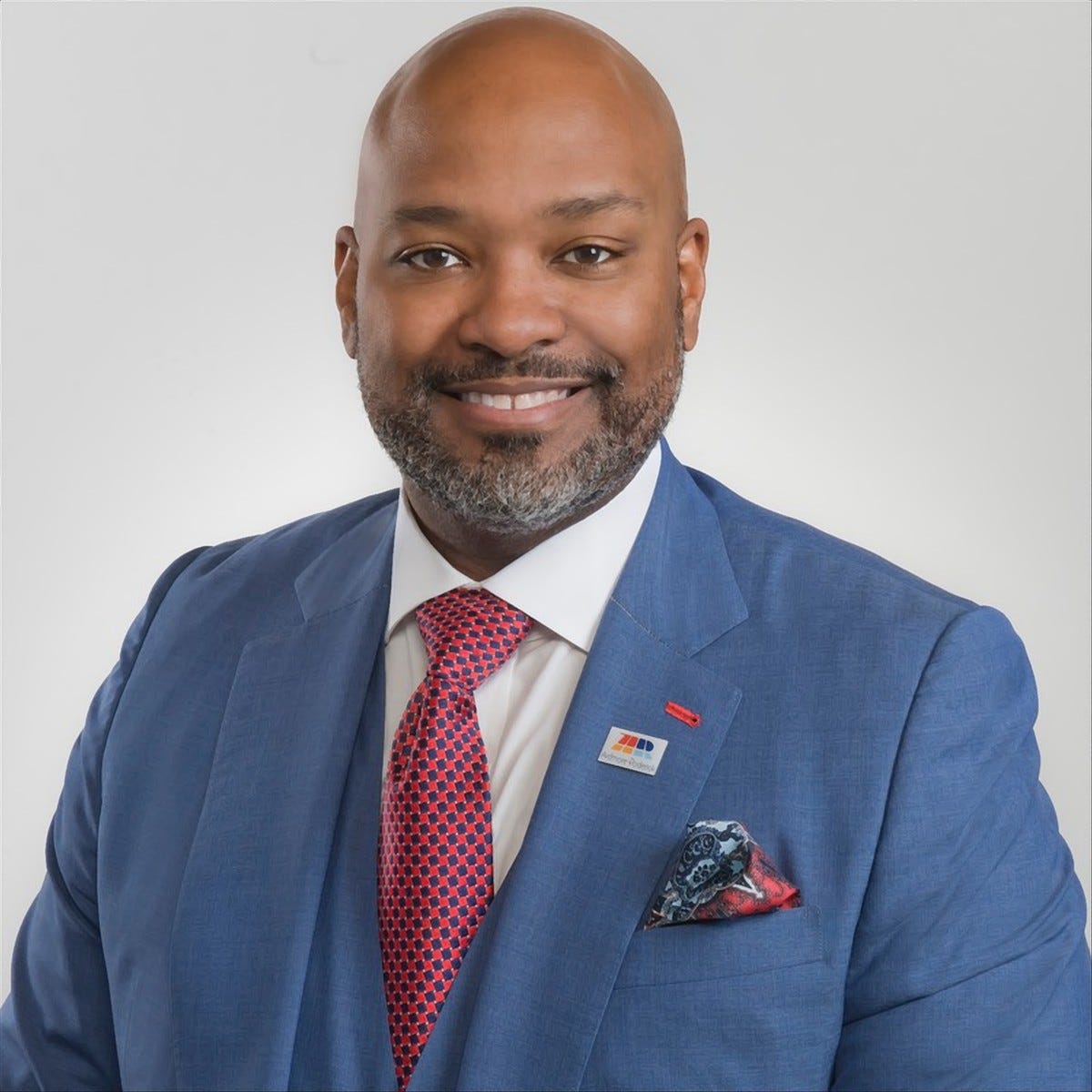
Rashod R. Johnson is an entrepreneur and businessman with the “Midas touch” who leverages a strong leadership mindset and 20+ years’ experience in construction and engineering to scale businesses from local leaders to multi-state powerhouses. He founded The Roderick Group, Inc. in 2005 and acquired Ardmore Associates, LLC in 2017 to become Ardmore Roderick, a full-service infrastructure engineering firm. Under Rashod’s leadership Ardmore Roderick employs over 225 people and has grown into one of the top 5 Black-owned infrastructure and construction engineering firms in the US.
From 2008 until 2018 Rashod was President and CEO of Material Service Testing & Laboratories, a construction materials testing, engineering and research firm. Within three years of purchasing and leading the firm, he grew it from a $1 million business to a $6 million venture and later sold it for over ten times the purchasing price. Rashod’s early career includes serving as the Director of Engineering for the Mason Contractors Association of America, Accounts Manager for Applied Industrial Technologies and Assistant Project Engineer / Engineering Intern for Walsh Construction Company of Illinois.
Devoted to serving his community on the South Side of Chicago, Rashod is currently a Board Director for the South Side YMCA of Chicago, a Board of Trustee Member for the Museum of Science and Industry, Chicago, and a member of the African American Chambers of Commerce of Central Florida and Illinois. Rashod’s past community and association involvement include Year-Up Chicago, YMCA of Metropolitan Chicago, National Society of Black Engineers and Alpha Phi Alpha Fraternity, Inc.
Rashod earned an MBA from the University of Notre Dame, a MS in Civil Engineering from the University of Illinois at Chicago, and a BS in Civil Engineering from the University of Illinois, Urbana-Champaign. His most impressive achievement, however, is being a #girldad to his daughter, Leila.
Thank you so much for joining us! Can you tell us a story about what brought you to this specific career path?
Math and science have always come easy to me. My mother, a PhD in Education, always challenged me with real-world math and science problems that I enjoyed solving. A former fat kid, my mother would give me my own basket in the grocery store. If I could predict within $1 of her total bill, I got my basket. It took me years to get it. However, when I did, she changed the rules to include tax and then it had to be within a dime. A year later, I was back to my basket. It was a game that fine-tuned my mental math in a way that few have mastered.
While in high school, I placed in AP Physics sophomore year. Because I seemed to grasp physics easily, my physics teacher, Mr. Gobelbecker—mechanical engineer by trade—told me about an engineering internship program that was being started by one of my school alumni. I facetiously told him I was not interested in driving trains. Then he told me that the internship paid $7.50 / hr. in 1991. This may as well have been $1000 / hr. That summer, I began working for a family-owned company called Walsh Construction, a $5 billion construction conglomerate today. This started my interest in civil engineering and construction and influences me still to this day.
Can you tell us a story about the hard times that you faced when you first started your journey?
Early on at The Roderick Group, things were hard often. Access to capital proved to be the biggest hurdle. Most banks wanted significant collateral to extend a line of credit and no one was lending money due to the 2008 financial crisis. I owned two successful engineering firms and took little to no salary for 2 years so that I could fund operations and payroll. I borrowed money from family, cashed in retirement and even factored receivables at one point, all to make ends meet. Every other Wednesday I nervously made calls to clients begging for payments to make Friday’s payroll. This would go on for 3 years before stabilizing.
Where did you get the drive to continue even though things were so hard?
My father worked for the US Postal service for 35 years before retiring and starting his own small business. He would often tell me that he should have quit years earlier. So, I started The Roderick Group in 2005 while working full time as a structural engineer. While the company was up and running, I didn’t quit my full-time job for the first couple of years. The timing never seemed right until one day I stumbled upon a church to visit and the preacher literally preached a sermon directly to me. His words ring loud in my head to this day, “you’ve already started your dream, dive in full-time and God will take care of you.” I knew in that moment that this company was my Purpose. During the early years, I literally quit 10 times in my head, but when you are centered around your God-ordained purpose, quitting seems impossible.
So, how are things going today? How did grit and resilience lead to your eventual success?
Fantastic! I started my firm in my attic on the South Side of Chicago in 2005 and today we stand as one of the 5 largest Black-owned infrastructure engineering firms in the US. Because I started the firm as a one-man show, I have experience in every facet of the firm. I have done marketing, procurement, design, construction management, finance, administration, IT, facilities, garbage man and many more roles. This experience provides me a certain humility and understanding that every single role in the firm is important, no matter how big or small. It also affords me a level of humility and connection to my team that is unmatched.
Can you share a story about the funniest mistake you made when you were first starting? Can you tell us what lesson you learned from that?
Early in the firm, I pursued a transportation project that I felt like we were sufficiently qualified for, but we were not chosen. I was told by a mentor that when not selected you should always ask for a post-denial debrief. So, I set up a meeting with one of the Deputy Commissioners, put on my suit and went to talk to him. In this meeting, the Deputy Commissioner looked at me and said “who are you?” I replied “I am Rashod Johnson, President of…” he said louder “I asked, who are you?” Confused, I again replied “I am Rashod...” now he yelled “YOUNG MAN, WHO THE F$%& ARE YOU?” I was stunned and sat in complete silence. He then asked how I expect to win any work with his department if no one knows who I am? This is an industry based on relationships. He told me next time you submit a proposal, make certain we know WHO YOU ARE! I finally understood what he was saying and I committed to building relationships in the industry to help my firm win more work. Lesson learned.
What do you think makes your company stand out? Can you share a story?
I believe that our culture is our major differentiator. While we have the technical qualifications and experience that rivals many national firms, we do not have a “big firm” culture of production, formulas, billable hours and stock prices. We are a familial culture and really seek to get to know our teammates and their families. In 2018 we had our first ever executive retreat. At this retreat I asked each executive “who is your biggest client?” Each answered differently except for the VP of Administration. She replied, “our people.” I exclaimed “YES!” I then said to my Exec Team that each of their biggest clients are their teams. If we take care of our people, our people, will take care of our clients. This is how we run the firm—employee focused, client centric.
Which tips would you recommend to your colleagues in your industry to help them to thrive and not “burn out”?
Understand your purpose and walk in it. Purpose is often about someone other than yourself. This gives you the ability to dig deep and find energy when there is none left; to find drive and desire to succeed when all odds are against you. But more importantly, to find the “why” in your purpose. However, you must possess the understanding that sometimes purposes are like seasons and they can change over time. Stay connected to yourself to understand the changing of purpose.
None of us are able to achieve success without some help along the way. Is there a particular person who you are grateful towards who helped get you to where you are? Can you share a story?
I often say “no one does great things alone.” There is no such thing as a “self-made” person. Everyone has help—EVERYONE. Whether it’s a grade you didn’t quite deserve or funding you didn’t quite qualify for, or a contract that a client took some risk to award to you, everyone has help.
That said, I have had SO much help from so many people that it’s hard to pinpoint just one. However, because of this abundance of help, I know that part of my purpose is to pay it forward and help others in similar and different situations.
Back in the early days of The Roderick Group, access to capital was next to impossible. The financial crisis of 2008/2009 was in full effect and banks were tight with their lending. To continue to operate, my parents, Robert and Glenda Johnson, took over $250k in loans out from their pension funds and gave it to me to fund operations for the firm. That is how much they believed in me. It was an act that saved the firm early on, but also demonstrated my parents’ love for me, that they were willing to risk their retirement funds to help me and the firm. Being the savvy business people they are, I had to have my attorney review a full business loan agreement and was even charged interest! In hindsight, I wouldn’t have done it any other way.
How have you used your success to bring goodness to the world?
I think this first starts with just being a good role model and example to my daughter, family, friends and colleagues, both within and outside the firm.
What are your "5 Things I Wish Someone Told Me Before I Became a Founder or CEO " and why. Please share a story or example for each.
Cash Is King
Everything costs money. Engineering services are often rendered 3-5 months before being paid for them. This requires the cashflow to be able to withstand this burden. The more you grow, the more capital is needed, and it becomes a vicious cycle until cashflow finally catches up with the operations of the firm, which in some cases can be years.
Employees First
As the firms grew, I realized that I cannot be everywhere at once. I needed to hire and develop a team of people who will take care of clients the same way I would. In many cases keeping this team motivated and excited to work has little to do with pay, though it’s important. I developed a culture that puts our employees first. I believe that if the firm takes care of our employees, our employees will take care of our clients. Even people who move on to other opportunities outside the firm will tell you that we value our team and I want to keep that reputation within the industry.
Relationships (Inside and Outside the business)
The engineering industry is based on experience, as such, we don’t bid work. This means that we need to be very deliberate in how we communicate our experience externally. In addition, we need to have relationships with the decision makers so that they know about our experience without reading the 200-page proposal. This will shape their impression of the firm whilst evaluating the proposals and give us a much better chance at being successful. In the end, most people want to do business with people they like.
Relationships outside the business are just as important, if not more. The right accounting team, legal team, consulting team, bankers and other advocates are critical to ensuring the long-term success of your business. Develop these relationships early so that when you DO scale, they are already in place.
Get the right people on your bus and in the right seats
Hiring the best team possible is critical in service-based industries. This doesn’t mean always hiring the smartest, or the most billable, or the most efficient, this means hiring the best fit. Once you have the best fits on the team, it’s then best to make certain that they are in the right spot on the team. All great engineers are not meant to manage others. Equally, great managers may not always be the best technically, but they are the best for that role at that time. In other words, they are in the right seat on your bus. This discernment isn’t always easy, but it’s critical in managing.
Don’t hire smart people in order to tell them what to do
Steve Jobs said “it doesn't make sense to hire smart people and then tell them what to do. We hire smart people so they can tell us what to do.” I love this quote. As technical people, we all feel a need to over manage in order to produce a very specific desired outcome. In the end, over managing is detrimental to the efficiency of everyone involved and can sometimes make people feel that they are not smart enough to do it on their own. Allow for a bit of flexibility and you may realize that there are many ways to achieve a desired outcome, maybe even better than expected.
You are a person of great influence. If you could start a movement that would bring the most amount of good to the most amount of people, what would that be? You never know what your idea can trigger. :-)
I want to start a venture capital fund to provide access to capital for Black-owned businesses in the AEC industry to grow to scale. Scaling a business takes vision, planning, execution and more importantly, CASH! In the 15 years I have been in business, I have overseen the growth from an idea in the attic of my south side of Chicago bungalow to a $50 Million annual revenue. Our goal is to double in size within the next 5 years. As we grow, I am creating a “roadmap” to show others how to scale in this industry and with some capital, will show interested firms how to scale up in a ¼ of the time. My goal is to create $1 billion of Black wealth in the AEC industry through investments and consulting before I truly retire.
How can our readers follow you on social media?
Twitter - @ArdmoreRoderick
Facebook – www.facebook.com/ArdmoreRoderick
LinkedIn - www.linkedin.com/company/the-roderick-group-inc-/