My dad always had partners, and then my brothers, their wives, their kids, my grandmother, my uncle — everyone started living in the house together.
Pop Culture
Nina Conti and Shenoah Allen: Inside the Quest to Redefine Comedy and Character Identity Through Independent Film
Acclaimed performers Nina Conti and Shenoah Allen discuss their creative partnership, artistic evolution, and the emotional resonance behind their dark comedy film Sunlight.
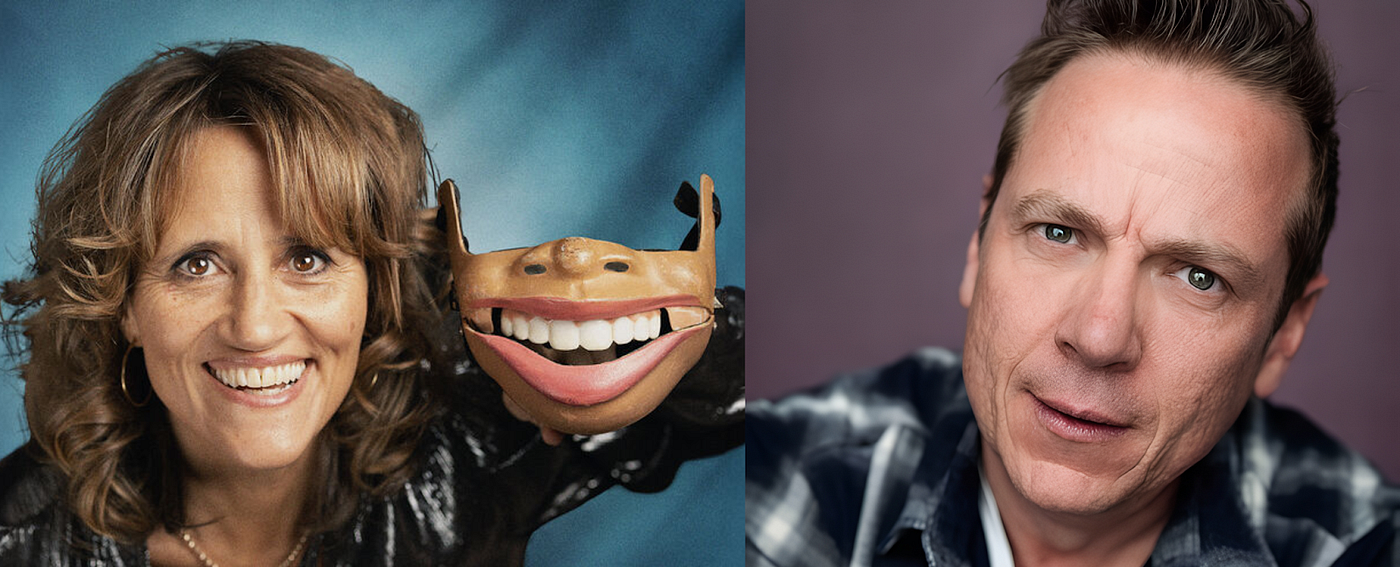
I had the pleasure of interviewing Nina Conti and Shenoah Allen.
Nina Conti, born in Hampstead, north-west London, has carved an unusual and inventive path through British comedy, combining classical acting roots with ventriloquism, improvisation and documentary filmmaking. The daughter of actors Tom Conti and Kara Wilson, Conti grew up as an only child and was educated at King Alfred School before earning a first-class degree in philosophy from the University of East Anglia in 1995.
Although her early life did not clearly signal a future in comedy, there is a hint of foreshadowing in a childhood home movie, in which a young Conti is seen with a monkey puppet on her hand — an image she later described as “eerily prophetic.” Initially drawn to the stage, she trained in classical theatre and spent the 2000–2001 season with the Royal Shakespeare Company. Her trajectory shifted after working with experimental theatre director Ken Campbell, who wrote a piece for her titled Let Me Out!!! at the 2001 Edinburgh Fringe. That collaboration proved pivotal. Under Campbell’s encouragement, Conti began exploring ventriloquism, adopting a monkey puppet that would soon become both her alter ego and comedic foil.
Conti’s breakout came swiftly. In 2002, performing with the puppet now known as Monkey, she won the BBC New Comedy Award, establishing herself as a regular at London’s Comedy Store. Her first full-length solo show, Complete and Utter Conti, debuted at the Edinburgh Fringe in 2007 and later won the Barry Award at the Melbourne Comedy Festival. Her distinctive use of audience masks and multiple characters added a spontaneous, freeform quality to her performances, often turning audience members into unwitting participants.
Television followed, with Conti appearing on popular UK shows such as QI, Live at the Apollo, and 8 Out of 10 Cats Does Countdown. In 2013, she appeared in Family Tree, a mockumentary series by Christopher Guest for HBO, further expanding her reach beyond the stage.
Beyond comedy, Conti has delved into the emotional and introspective dimensions of her art. Her 2012 documentary Her Master’s Voice, in which she travels to the Vent Haven Museum in Kentucky with the puppets of her late mentor Ken Campbell, won the SXSW audience prize and was later nominated for both BAFTA and Grierson awards. The film, a meditation on grief, identity, and the nature of performance, marked a turning point in how ventriloquism was perceived in contemporary media.
In 2024, Conti completed her first feature film, Sunlight, a dark comedy she wrote, directed, and starred in alongside her creative partner Shenoah Allen. The film, shot in New Mexico, premiered at the Edinburgh International Film Festival and explores themes of identity and self-liberation through the metaphor of a woman retreating into a monkey suit. Conti has described it as “a comedic metaphor” for the desire to shed one’s public or private personas. The film opened in UK cinemas in June 2025 following a successful festival run.
Live performance remains central to Conti’s career. Her touring show The Dating Show ran in 2021–22, and she returned to the road in 2025 with Whose Face Is It Anyway?, an unscripted mask-driven show that played London’s Apollo Theatre and continues touring nationally. A mainstay of the Edinburgh Fringe, she brings her blend of improvisation, audience interaction, and character-driven comedy to stages across the UK.
Off-stage, Conti has remained active in digital media. She created the improvised YouTube series In Therapy and co-hosts the relationship-themed podcast Richard & Greta with Allen. In 2019, she reached the final four on CBS’s international talent competition The World’s Best, further broadening her global profile.
Conti’s personal life has occasionally intersected with her professional one. She was previously in a relationship with her mentor Ken Campbell and later married fellow comedian Andrew “Stan” Stanley. The couple, now separated, have two sons, including actor Arthur Conti.
Despite — or perhaps because of — the chaotic energy of her performances, Conti is often praised for her control and timing. A 2025 review in The Guardian described her as “in supreme command of her comedy chaos,” with a knack for transforming audience members into “human dummies” while maintaining full narrative control.
Reflecting on her craft, Conti often speaks about the liberation found in performance, particularly through her Monkey character. “I use him to voice my own thoughts,” she said in an interview. “He really is part of me now.” Her work, whether on stage or in film, frequently explores the boundaries between identity and performance, seriousness and absurdity.
In recent years, Conti has increasingly blended her comedic sensibilities with emotional honesty. Her projects suggest a willingness to explore discomfort, vulnerability, and contradiction — not only for the sake of comedy, but also as a form of personal and artistic exploration. Today, Nina Conti remains one of the most distinctive voices in British comedy, continually expanding the reach and resonance of ventriloquism as both a comedic and artistic form.
Shenoah Allen, an American comedian, writer, and performer, emerged from Albuquerque, New Mexico’s improv scene to become a distinctive presence on the international comedy circuit. Best known as one half of the long-running sketch duo The Pajama Men, Allen has since diversified into solo work, voice acting, directing, and a creative partnership with British comedian Nina Conti.
Allen’s early creative grounding came at La Cueva High School in Albuquerque, where he joined the school’s improv troupe in 1993. It was there he met Mark Chavez, the collaborator with whom he would later form The Pajama Men. Their partnership began with small college-town performances under the name Sabotage before they debuted a trio of original sketches at Tricklock Company’s Reptilian Lounge. By 2004, the pair had adopted their enduring moniker and took their minimalist, character-driven shows to the Edinburgh Fringe Festival, launching a touring career that would span two decades and multiple continents.
The Pajama Men became fixtures on the festival circuit, known for their rapid character switches, sparse staging, and darkly comic storytelling. Their 2009 show Versus vs. Versus earned the Barry Award at the Melbourne International Comedy Festival and swept honors at the Sydney Comedy Festival, including Best Newcomer and Best of the Fest. They also received a Perrier Newcomer nomination at Edinburgh and later Chortle nominations for their follow-up The Last Stand to Reason. The Guardian and other UK press routinely awarded five-star reviews, citing their tight writing, improvisational agility, and ability to conjure entire worlds with little more than body language and suggestion.
Parallel to his work in the duo, Allen has developed a solo career marked by character-based stand-up and autobiographical material. His 2024 show Bloodlust Summertime — which appeared at the Machynlleth Comedy Festival, Soho Theatre, and the Edinburgh Fringe — offered a blend of personal narrative and dark comedy, reflecting on family, identity, and the surreal elements of everyday life. Critics noted the show’s deft balance of absurdism and emotional candor.
On screen, Allen’s credits are eclectic, ranging from a cameo in Breaking Bad to supporting roles in independent features such as Romeo & Juliet vs. The Living Dead (2009), The Last Sparks of Sundown (2014), and Grace Under Pressure (2019). He appeared in Benedict Cumberbatch’s Cold War thriller The Courier (2020), and his interest in animated storytelling led to the 2010 Sundance-screened series One Square Mile of Earth, which showcased his flair for visually idiosyncratic, voice-centric narratives.
Allen has also worked extensively behind the scenes as a writer and director. He has developed pilots and screenplays for networks including HBO, the BBC, Film4, and Paramount, and directed the 2015 stand-up special Nish Kumar — Ruminations on the Nature of Subjectivity. His writing often reflects the themes seen in his live work — quirky, emotionally nuanced, and linguistically inventive.
In 2024, Allen and Conti completed their first co-written feature film, Sunlight, a road comedy exploring themes of identity and emotional retreat. The film, which premiered at the Santa Fe International Film Festival with Christopher Guest as executive producer, tells the story of two misfits whose internal struggles are externalized through surreal behavior — most notably a woman who lives in a monkey suit. Allen described the work as “a liberating film,” highlighting its combination of absurdity and tenderness. The film screened at the Edinburgh International Film Festival and received a limited theatrical release in 2025, with digital platforms to follow.
Allen has lived in London for more than a decade, drawn by the city’s dense club circuit and appetite for experimental performance. A Creative Associate of Soho Theatre, he frequently previews new solo material in its studio spaces, continuing to evolve his voice within and beyond the festival format.
His style remains anchored in improvisation, physicality, and a minimalist aesthetic that often relies on blank stages and loose costumes to conjure elaborate narratives. Audiences and critics alike note his ability to populate scenes with multiple characters through rapid voice and posture shifts, often revealing the full picture only in a show’s final minutes.
Throughout his career, Allen has emphasized trust, play, and creative spontaneity. “If there’s something that defines what I do,” he said in a 2024 interview, “it’s those moments when you feel really alive in the improvisation… there’s this deep trust.” That ethos has carried through both longstanding collaborations and newer ventures, underscoring a career that resists easy categorization.
Yitzi: Nina and Shenoah, it’s a delight to meet you. Before we dive in deep, our readers would love to learn about your personal origin stories. Nina, can you share the story of your childhood and how you grew up?
Nina: You really want to go that far back? I grew up as an only child, and there are jokes that that’s why I talked to dolls and later became a ventriloquist. But honestly, there wasn’t anything in my childhood that suggested I’d end up doing this. There’s a Super 8 movie from when I was about nine, where I’m running out of the house, and if you pause it, you can see I’ve got a monkey puppet on my hand. It’s completely eerie because I don’t remember it, but there’s photographic evidence. So maybe the tracks were laid early.
Shenoah: Yes, the story of my childhood. How long do you have? I come from sort of a unique background. My dad is gay, and he, his partner, and my mother all cohabitate in a communal, off-grid house in the foothills of the Sandia Mountains in New Mexico. That was my example growing up, so I never knew anyone thought being gay was unusual. In a way, the whole coming out story happened in reverse for me. It was only when I met people from different backgrounds that I realized, oh, you guys don’t do it like this.
It’s a very loving and fun family. My grandfather was a NASA engineer, and I grew up surrounded by a lot of people. My dad always had partners, and then my brothers, their wives, their kids, my grandmother, my uncle — everyone started living in the house together. It was a pretty wild ride, but I think we learned a lot about communication through that. I hope so.
At a pretty young age, I discovered improv comedy, and I kind of never looked back. I’ve been playing wild characters ever since. That was my safe space — playing ludicrous characters — and years later, that’s how I eventually met Nina, on the comedy circuit.
Yitzi: So, Nina, you must have some amazing stories from your successful career. Can you share with our readers one or two that really stand out in your mind?
Nina: I’ll go with a couple of the weirder ones that maybe aren’t totally representative of my whole experience. I’ve done everything from underground comedy gigs in cellars that were basically fire hazards to performing at Windsor Castle for the Queen’s 90th birthday. I’ve done a lot of shows over the years — more than 20 now — and that little monkey puppet, which I discovered by accident, has been with me the whole time.
I use him to voice my own thoughts, and it’s been a liberating process. I’ve spent so much time in that character that he really is part of me now. That’s actually where the idea for the film came from. I wanted to explore what life would be like if I shed the more agonizing parts of myself and just became that character fully.
That led to Sunlight and to my collaboration with Shenoah. I really wanted to work with him because he’s such a great improviser, and I had just gotten this monkey suit made. We started doing some gigs together, and we had great chemistry. That’s how it all began.
Shenoah: What stands out most? I really don’t know if there’s one moment. I spent 20 years touring in a comedy double act, all over the world — from tiny gigs to places like the Sydney Opera House. Honestly, one isn’t better than the other.
If there’s something that defines what I do, it’s those moments when you feel really alive in the improvisation. Anything can happen, but it works because you and your partner are hyper-aware of every tiny moment. You know each other so well, and there’s this deep trust. I had that with my previous comedy partner, and I’ve found that again with Nina.
It’s incredibly exciting when you have that kind of connection and play. I can’t name one defining moment, but that feeling — that electric current you thrive on — is what I always look for. When it’s there, it’s pure fun. When it’s not, it’s a lot of work.
Yitzi: So let’s talk about Sunlight. Nina, tell us why you think we have to watch it.
Nina: I think there’s an emotional logic to it that will resonate with a lot of people. Even though my idea — to get into a monkey suit and not get out — is extreme in some ways, I think society gives us a million ways to do exactly that. Whether it’s through a character, how we present ourselves to the world, what we do to fit in or stand out, how we speak online — whatever form that avatar takes. There’s something very human about wishing you didn’t have to be you. Not everyone feels that way — some people are quite content with themselves — but I think many people can relate. And this is a comedic metaphor for that. We worked really hard on the story. It’s fast-paced, the heart of it is wide open, and there are a lot of jokes. From the screenings we’ve had, people have been incredibly moved and have even said they want to see it again. So I’m really excited for people to experience it and see what it brings up for them.
Shenoah: I think it’s a liberating film. And — this might sound hokey — but it shows how love can grow, even in the cracks in the sidewalk. These are unusual characters, coming from difficult situations, and they find each other. They find a way to connect. The circumstances may seem outlandish, but the film is grounded. It’s sweet, even though it’s bold in its choices. It goes places most people wouldn’t instinctively go, and I hope people find that liberating. And it’s funny — that’s a big part of why it works.
Nina: It almost feels like you’re watching something private, in a way, because it’s a world we shared for a long time before putting it on film. It has its own reality. You feel like you’re watching something that truly exists — and you are — even though it’s very unusual.
Shenoah: Yeah, we spent five years together on the script. We created this world in a big way, through so many versions in our imaginations. By the time we got to filming, we knew these characters intimately. We were able to improvise a lot within the structure of the script because we knew exactly how they’d respond. I think that gives it something really special. It’s the kind of thing you might only get to do once in your life. Maybe we’ll get to do it again, but this one was definitely hard-earned.
Yitzi: So Nina, how would you compare and contrast your personal character, Nina, with Jane from the film? How are you similar and how are you different?
Nina: Oh gosh, that’s really making me think. We’re similar in the fact that we both take refuge in an alter ego. I was going to say she does it more fully, but honestly, you can barely do it more fully than I have over 20 years. I’ve committed to the truth of an alter ego in ways that very few people would. There’s a desperation to avoid boredom. A ticking clock, like life is running out. Let’s not let it be boring, and let’s not suffer any nonsense. We’ve got to live. We’ve got to live now and stop compromising. That’s the beating heart of Jane, and that leads her to make some bad decisions — definitely — and probably me too.
Yitzi: Shenoah, how are you different than Roy?
Shenoah: I don’t know. I basically based Roy on me, so I’m not sure how different we are. It’s not autobiographical, but it’s emotionally autobiographical, I guess. I think what’s different is Roy has terrible parents and a kind of backstory that isn’t mine. I had a pretty eclectic childhood and definitely saw my share of… call it what you will, but I came from a loving family. That’s the big difference, maybe, between me and Roy. I don’t actually have it in for my dad like Roy does.
Yitzi: What message do you hope society takes from the themes and motifs of the film?
Nina: Sometimes you have to do the wrong thing to take the right path. The worst decision can be the best one. There are things to be learned in those bad decisions. That was kind of our premise. “Do it wrong to make it right,” kind of thing. It’s like a good comedy, where if someone is always committed to the worst choice, they work harder to make it okay in the end. But that “okay” might be something deeper.
Shenoah: What should society take? It’s a very “be who you are” kind of film. I think society could really use more of that.
Nina: Yeah, that’s well put.
Yitzi: That’s great. So this is our signature question. Each of you have been successful comedians. Can you share from your experience five things that you think are essential to being a successful comedian?
Nina: I think you have to love the people who come to see you, who go out because they want to laugh. You’ve got to take any lying or posturing out of your repertoire. You have to keep showing up. You’ve got to do a lot of bad gigs, get those out of the way, and learn from them. Is that five? I think so. Also, be funny. Funny has to come before ego.
Shenoah: I think Nina already said them all. I agree. You really have to love your audience. You have to enter the room with them — you’re in it together. Work with people who make you laugh. Don’t spend too much time competing with others mentally. And on that note, not to make all of mine negative, but don’t work with naysayers. Watch out for professionals who just want to show how smart they are by telling you why something won’t work. I say that’s a bunch of hooey. You’ll find a way to make it work, and you should work with people who say, “I don’t know how to do that, but I’ll find a way.” And leave your script. In comedy, if you’ve worked it out word for word and you stick to that every night, you’ll end up stuck in a little cage of your own words. Trust that it’s going to be all right if you step out on a limb. Keep showing up.
Yitzi: That’s great. So this is our final aspirational question. Both of you, because of the platforms you’ve built and your great work, are people of enormous influence. Nina, if you could put out an idea or inspire a movement that would bring the most good to the most people, what would that be?
Nina: Everybody, from now on, every day, has to wear a puppet that tells everyone what they’re really thinking. It’s a prescription for everyone.
Shenoah: I would like to see that. Jeez,
I mean, that’s a big question. I think we should start to take it upon ourselves to save the things that are valuable in society and the world, because we can’t rely on politics. It’s not working. It needs to be grassroots. So let’s clean up the oceans, save the universities, love one another, and hurrah.
Yitzi: Amazing. So how can our readers watch the film? How could they support you in any possible way?
Nina: The film is coming out in New York and LA first, at the Quad Theater and the New Art Theater. It’s also going to be in some other places like Nebraska and New Mexico, and we don’t know everywhere yet. Eventually, I think later in July, it’ll be on Apple and Amazon. I’m not sure of the release date for that yet, but hopefully our people who are in touch with you will know.
Shenoah: Yes, and look for us on our socials so you can keep track of where the film’s going next. Follow our socials. Nina Conti and Shenoah Allen, respectively.
Yitzi: Nina and Shenoah, it’s been such a delight and a joy to meet you both. I wish you continued success and good health. I hope we can do this again next time.
Nina: Thank you, likewise.
Shenoah: Thank you. Thank you for the interview.
AM
Written by
Authority Magazine Editorial Staff
Editorial Desk · Authority MagazineThe Authority Magazine Editorial Desk produces, verifies, and edits long-form primary-source interviews with executives, innovators, clinicians, creators, and social impact leaders across Business, Tech, Pop Culture, Wellness, and Social Impact.

Published inAuthority MagazineTop Lessons, Top Authorities · 42K Followers
Exclusive, curated interviews with the leaders and changemakers shaping tomorrow. Leadership lessons, industry deep dives, and executive profiles.