One of the most interesting stories from my career involved taking care of a patient who was a transgender African American woman from South Carolina. She grew up with her mother and, as she was transitioning from male to female in the household as a teenager, faced a lot of disapproval from her relatives.
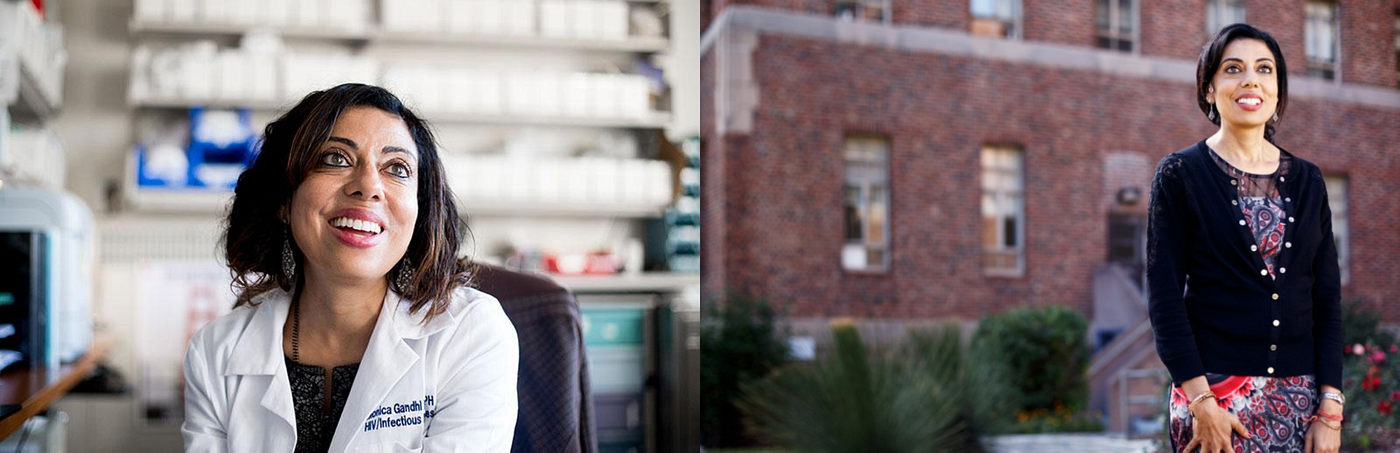
I had the pleasure of interviewing Monica Gandhi MD, MPH and Cynthia-Carey Grant. Monica and Cynthia are local co-chairs of the 23rd International AIDS Conference (AIDS 2020), which is the largest conference on HIV and AIDS. Monica is a UCSF professor of medicine in the Division of HIV, Infectious Disease, and Global Medicine and Medical Director of Ward 86, which played a historic role in the treatment and prevention of HIV/AIDS. Cynthia is the former executive director of Women Organized to Respond to Life-threatening Diseases (WORLD), an Oakland-based agency serving women with HIV/AIDS.
Thank you so much for joining us Dr. Gandhi. Can you share with us the most interesting story from your career? Can you tell us what lessons or ‘takeaways’ you learned from that?
Iam an HIV doctor at the University of California, San Francisco (UCSF), so most of my patients are living with HIV and some are on PrEP. One of the most interesting stories from my career involved taking care of a patient who was a transgender African American woman from South Carolina. She grew up with her mother and, as she was transitioning from male to female in the household as a teenager, faced a lot of disapproval from her relatives. She experienced both physical and emotional abuse as a result of her transition. She came to San Francisco to “be free” from the prejudices of this experience. While she still experienced stigma in San Francisco, it was much less than the amount she encountered growing up. She gradually fell in love (twice), got married and is now working full-time living with her husband and their three dogs. She recently went back to South Carolina, and I had an opportunity to talk to her mother by phone to explain to her mother how well she was doing in her life and with her HIV treatment. She’s had an increasing acceptance of her transgender status from her family in the South as she learned to accept herself. I think our clinic (Ward 86 at San Francisco General Hospital), by making her feel so loved and supported, played a role in this acceptance and rapprochement.
None of us is able to achieve success without some help along the way. Is there a particular person you are grateful toward who helped get you to where you are? Can you share a story?
Yes, I am very grateful to Drs. Diane Havlir and Eric Goosby, who have each helped me in my career. Dr. Havlir is the Chief of the Division of HIV, Infectious Diseases and Global Medicine at San Francisco General Hospital, and served as the Co-Chair of the International AIDS Conference in 2012 when it returned to the United States for the first time after 22 years (after President Obama lifted the travel ban on those living with HIV). Over the years, she has provided me with various opportunities to fulfill my passions through my job at UCSF, including appointing me as the Medical Director of the Ward 86 HIV clinic (one of the oldest HIV clinics in the world) in 2014, a position I have happily held since then. Dr. Havlir’s passion for HIV work, her commitment to us as faculty and colleagues, and her compassion for anyone who has struggled in their life from stigma is apparent and permeates all of her amazing work. Her stream of innovative ideas never dries up!
Dr. Eric Goosby — former head of the PEPFAR program from 2009–2013, the first Executive Director of the Ryan White Care Program, and a leading Global Health Professor at UCSF — has influenced me most from his examples of kindness. Eric is one of the most humble and compassionate people I know, despite being highly accomplished. He is always stopping his work to provide support to early-stage investigators and trainees. Both of these leaders have helped me get to where I am today and I am so grateful to them for their support.
When you think of resilience within the context of HIV and AIDS advocacy, which person(s) comes to mind? Can you explain why you chose that person(s)?
Many of my patients come to mind when I think of resilience in the context of HIV and AIDS advocacy. One of my patients is an African American woman who is the first person in the world with HIV to have received a heart transplant (for postpartum cardiomyopathy). She has since served as an incredible advocate for those living with HIV to receive organ transplants and has been tireless in her advocacy of continued access. Moreover, she has suffered from both stigma and depression, and she continues to display amazing resilience in the face of such adversity. She gave a talk for the UCSF medical students last year and inspired half of them to go into HIV with her passion! She comes to mind when I think of resilience because she inspires me every day in my work and in my own life to continue on, despite setbacks.
Has there ever been a time working within the HIV and AIDS community that someone told you something was impossible but you did it anyway? Can you share the story with us?
Yes, I was told that it was impossible to start a novel program for the care of people living with HIV (PLHIV) and homelessness. The person told me that the only way to fix the problem of PLHIV for those who were marginally housed and had poor rates of virologic suppression was to find everyone housing. Although we have advocated fiercely and continuously for housing for PLHIV in the city of San Francisco, we also started a special clinical program for marginally housed patients at Ward 86 called the POP-UP HIV Program. POP-UP is a low-barrier access clinic where enrolled patients can come to Ward 86 at any time and have their drop-in visit converted to a primary care visit. Patients are given food support, clothing, incentives, pillboxes, substance use support (if relevant), mental health services (if relevant), and the same team of clinical providers to work on their personal goals of medical care and getting on HIV treatment/achieving virologic suppression. In the first six months of the program, we increased virologic suppression rates in our enrolled patients from 0% to 60%, and we hope to see enduring improvements in health via this novel program.
Did you have a time in your life where you had one of your greatest setbacks, but you bounced back from it stronger than ever? Can you share that story with us?
I have had many setbacks in my life and have bounced back from some, but not all. One of the setbacks I bounced back from was an event that occurred early in my career where I thought I wanted to be a pediatrician rather than an adult doctor. I received a marginal grade on my pediatrics sub-internship, which did not put me in good stead for matching at a competitive pediatric residency. I was devastated for a while but was then delighted when I actually entered my internal medicine residency. I realized how much I appreciated being able to talk to my adult patients and learn from them. Like many setbacks in one’s career, it ended up being an opportunity and the right thing.
Did you have any experiences growing up that have contributed to building your resiliency? Can you share a story?
I grew up in Utah as an Indian and that was NOT easy. I experienced a lot of stigma and racism because I was non-Mormon and a person of color in a place that was predominantly white. It was the experiences of my childhood that made me want to go into HIV because I knew what it felt like to be stigmatized by something outside of my control. I also had a friend in high school who came out to his parents and was kicked out of his house in the dead of winter, so I vowed to work with populations facing stigma and try to work on reducing it. As an adult, I have had many experiences that led to resilience, but the most profound experience of my life is still ongoing. My husband was diagnosed with cancer in 2010, two months after our second child was born. He passed away a few months ago from cancer. What I do now with this terrible loss and grief will be an ongoing story in resilience and character, and I do not know yet how this will turn out. I do know that I must provide an example for my children on how to deal with hardship with faith, gratitude, charity, hope, love and forbearance and that is what we are working on.
Resilience is like a muscle that can be strengthened. In your opinion, what are 3 to 5 steps that someone can take to become more resilient? Please share a brief story or an example for each.
I have seen numerous examples of resilience in my patients and am working on my own resilience in the face of tragic loss. One step to becoming more resilient is having faith that you are stronger than you think, which is something being tested for me right now. A second step is to cultivate love and kindness in yourself so you can model for others how people should be treated, even if you are being stigmatized for no reason. A third step is to form connections with people because of we — as humans — draw strength from each other. And a fourth step is to accept that change is a part of living — changes in health, changes in your body, change in relationships, including loss, and change as we age. But if we can accept that change is the only constant, we can have greater resilience in moving on and through change.
If you could inspire a movement that would bring the most amount of good to the most amount of people, what would it be? You never know what your idea can trigger.
I am very concerned with the increasing stigma, prejudice, and xenophobia worldwide, which will increase the risk of HIV infection, given that the infection is really one of social injustice. I would like to see a worldwide movement where we realize that we must consider the effects of our current actions on future generations in terms of both stigma and preserving the earth.
We are blessed that some very prominent leaders read this column. Is there a person in the world, or in the U.S. with whom you would love to have a private breakfast or lunch, and why? He or she might just see this, especially if we tag them.
I admire Alexandria Ocasio-Cortez. I find her passionate, compassionate, brave and very true to her principles. I would love to have a private meal with her to understand how I can help support her many awe-inspiring causes (including the Green Deal) and tell her how much I admire her work.