Being talented is not enough — you need multiple business skills and to be the ‘jack of all trades’. As someone driven by my passion, I have had to learn to become an entrepreneur, a networker, and a jugular of many tasks including accounts, bookkeeping and fundraising.
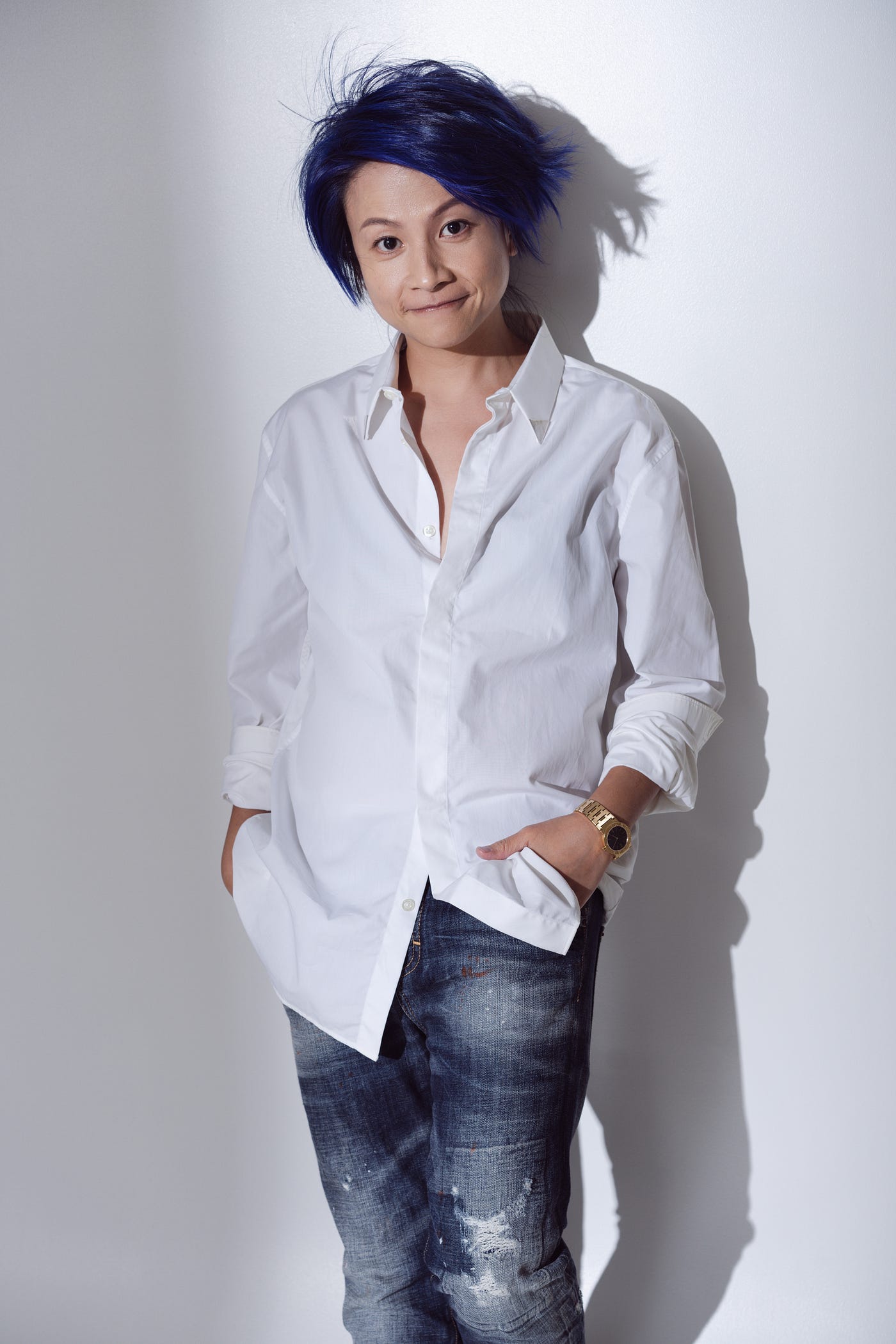
As a part of our series about “5 Things I Wish Someone Told Me When I First Became An Artist” I had the pleasure of interviewing Michelle Baharier.
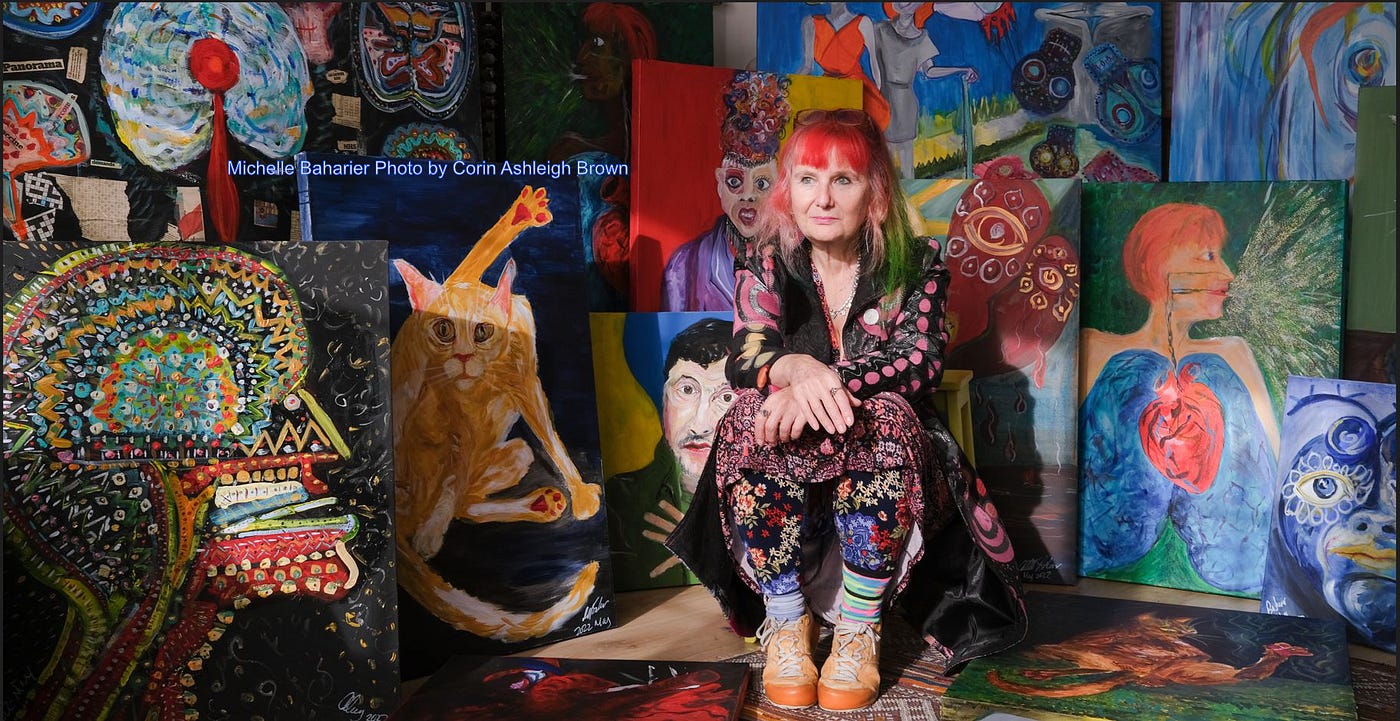
Michelle Baharier is an award winning interdisciplinary artist whose bright colorful paintings address the barriers that she and others face, due to disability discrimination and prejudice.
She is a graduate of the Slade school of fine art and exchange student at the Hochschule für Bildende Künste Städelschule, Frankfurt am Main, Germany. Michelle brings over forty years of gained expertise in visual arts. She founded and ran an Arts and mental-health charity from zero to 500k turnover, winning 27 awards, including the GSK IMPACT Award in 2015.
Thank you so much for doing this with us! Can you tell us the story of how you grew up?
It’s a very long story so here are the highlights:
I grew up in the UK in a family of three children. I was the youngest. My family are Jewish with very long histories.
I was diagnosed with dyslexia at age 9, which meant that I then had special education throughout my time at school.
My father died when I was 15 after spending three years in hospital. He had a brain tumor and in the 70s not a lot was known about that, so the treatments were crude and at times quite cruel.
I was expelled from school, and went on to another school. I headed over to College despite my dyslexia which was the best thing! I got into Art College because I made my own clothes. It was the punk era so making your own clothes was quite popular at the time. I knitted jumpers and drew some paintings from my imagination. I would often hang out in what is now Tate Britain, it was free and I would go and sit in the Mark Rothko room.
It helped me to deal with my depression. At age 14 I was diagnosed with clinical depression, which I have lived with my whole life.
From there I went to Art School, I did a degree in final art, and was on the first ever European Union exchange at the Hochschule für BildendeKünste Städelschule, Frankfurt am Main, Germany. Then I did the equivalent of an MA at the Slade School of fine art.
Once in the real world, I faced huge barriers to participation, there were no computers and you had to write letters and send slides of your portfolio through the post. At that point in time art was not as popular as it is now, although there were squats and other alternative places to the mainstream.
I became very heavily involved in squatting. I was homeless, so I spent seven years living in a squat. I also ran Squatted galleries, where I curated many art exhibitions and had a studio.
My Artwork was censored by the Big Issue at a show I was accepted for. I met a woman from the Arts Council and when she found out and took me to Texas San-Antonio. I continued to go and represent UK and Disabled women Artists in the US at the Women’s Caucus for Art (WCA) and I was on the World wide webs first created by Muriel Magenta.
I went on to develop the squat into a charity that worked with three thousand people with mental distress, had 24 staff and won 27 awards over 2 decades.
For those of you who know, health support in the UK has gotten worse over the last 10 years, and in many circumstances the occupational therapy element has been removed from hospitals, making people’s ability to have a sense of purpose a lot harder.
I now concentrate on my own artwork, for which I have currently just won an Axis bursary. I am also commissioned by the London Transport Museum to create a number of portraits of their staff, who are disabled for their disability archives.
Onwards and upwards.
Can you share a story with us about what brought you to this specific career path?
I am an artist because as a child and teenager I worked a lot on my mother’s Market stall. I found work futile and boring. So I wanted to do something creative I love.
Can you tell us the most interesting story that happened to you since you began your career?
Having my art censored! It was a picture of a policeman blocking a doorway to flats that were bordered up for demolition, this part was a photo montage and then I had collaged it with torn up magazines. It was called English Country Garden 1, as I made a series. The Big Issue is a magazine set up to help homeless people. They removed my work from the show as they said it was too political. Anyway, I did not know until I arrived at the show. Also this work had won a prize with the Natwest Banks, who used the image on their calendars. At the exhibition, I meet a woman from the arts council, she was looking for a disabled censored Artists to go the USA to give a talk and the next she called me on my land line and — off I went to represent the UK for the next 3 years at the Disabled Aomen Artists in the US at the Women’s Caucus of Arts.
What are some of the most interesting or exciting projects you are working on now?
I am working with London Transport Museum and painting their staff and telling stories of how ordinary people do extraordinary things to make change happen. So an example is an Autistic member of staff who helps distressed passengers, a simple act of kindness.
Who are some of the most interesting people you have interacted with? What was that like? Do you have any stories?
Other Disability activists, like Sue Elsegood who chained herself to Buss and got arrested and made change happen.
Where do you draw inspiration from? Can you share a story about that?
I get inspiration from everywhere, especially as I spend lots of time going for walks and riding the buses and I watch the world go by. I visit museums and read about history and I talk to people. One of my very odd likes is the Imperial War Museum which is full of the living and dead histories of people. Another is the London Transport Museum as it tells the stories of ordinary people and every day stories of work and play.
How have you used your success to bring goodness to the world?
I ran an Arts and mental charity for 25 years making Art for Arts sake. Many people involved with the charity were able to move on and get jobs, go to college and get on better with their families.
In my current work I paint a lot about my depression as well as my dyslexia. I am a disabled person myself and because of that I have had to be an activist, just so I can access simple things.
What are your “5 things I wish someone told me when I first started” and why. Please share a story or example for each.
1 . I wish someone had explained to me about Networking. We all know in theory what networking is, but how do you do it? Many people like me are shy, also when someone says go and make friends with that person, maybe you don’t get it. I come from a working class background and I just didn’t get it. I’d like a lesson in what to say, who to say it to and how to learn to talk to people you don’t know. As my Granddad once told me, it’s not what you know, it’s who you know.
2 . Being talented is not enough — you need multiple business skills and to be the ‘jack of all trades’. As someone driven by my passion, I have had to learn to become an entrepreneur, a networker, and a jugular of many tasks including accounts, bookkeeping and fundraising. I’ve had to become methodical and organized and learn to deal with practicalities like storage space and having a studio in my home.
3 . How to raise funds for your work, this may mean doing other work to subsidize your practice, get patrons and work with galleries and other art professionals — one needs heaps of self-belief and resilience. You could be adored by some & rejected by others all on the same day, you could receive both praise and criticism about the very same pieces of work simultaneously. In my case, I have won prizes from one entity and had the same work rejected by others. So talk about all the positives and not the rejections.
Also be aware that the galleries that want you to pay them a hire fee will probably not have a mailing list to grow your audience. This is a very gray area. The same for competitions as decided if money is involved what you are willing to spend are they worth it? What are your chances?
4 . Practice self-care too, as I need my strength. Appreciate what a privilege it is to create and be able to enjoy solitude while working.
5 . Be persistent and ambitious. Learn to sell your work not yourself but remain your authentic self. An artist’s work is not only something you are ‘enthusiastic’ about but something you are dedicated to.
You are a person of great influence. If you could inspire a movement that would bring the most amount of good to the most amount of people, what would that be? You never know what your idea can trigger. :-)
I would like to inspire people with the means to invest, to do so as Patrons of the arts. The Arts change lives, it keeps people healthy and vibrant. Kahlo said ‘I paint flowers so they don’t die’. I would like to see investment in the over 55’s who may, like me, have had to earn a living, juggling their Artists careers, with work and families. We are ignored and overlooked, as everything is geared to under 30’s, or your first 5 years after college. As a disabled woman, not only do I face endless barriers to participation, but also I can not participate financially, I could not afford to enter competitions, nor as my dyslexia was so bad could I write applications. Computers have helped a limited amount. What I and other Artists need are free to use studios and gallery spaces, the owner could just take commission. Also stipend to artists, especially older disabled Artists to just create. Some Artists like me, our work should be in museum’s as like Otto Dix, I paint the reality, not photo realism, but the underlying emotion. Our work is a historical statement.
We have been blessed that some of the biggest names in Business, VC funding, Sports, and Entertainment read this column. Is there a person in the world, or in the US whom you would love to have a private breakfast or lunch with, and why? He or she just might see this.
It would be amazing to have breakfast with Judy Chicago the painter, who shaped part of my feminist thinking as a young artist growing up. Or Patti Smith, one of my favorite song writers and poets. As a young person Punk Rock was a strong influence for me, I was a misfit and so was Punk, you didn’t have to be normal. Just like Laurie Anderson whose performance piece of 8 hours long with her ‘Oh Superman’ was stunning. I would also like to meet David Geffen, a very successful dyslexic person who is also extremely into collecting art.
What is the best way our readers can follow you on social media?
My art portfolio is available on https://michellebaharier.co.uk/ and you can follow me on Instagram here: https://www.instagram.com/bahariermichelle and Facebook here: https://www.facebook.com/MichelleBaharier
This was very inspiring. Thank you so much for joining us!